Blog

I blog about nature in the Norfolk countryside and about my wildlife garden. My blog blends digital photos with an analogue nature journal.

Nature journalling blends nature observation and citizen science with a written diariy or art journal to build a deeper connection with nature and cultivate curiosity, creativity and flow.

On The Importance of Ponds

Nar Cottage’s wildlife pond still going strong 13 years after it was made

I went outside yesterday and thanks to our showery spells things have greened up. Aside from a number of still bare patches of lawn you would hardly know we’d had such a brutally hot summer and long damaging drought.

At the pond the darter dragonflies were zipping about above the magenta Purple Loosestrife as always and perching up on the water mint as if nothing had ever happened.

There are subtle signs of course. I noticed that the animal pathways to the pond's perimeter are a bit more defined and more heavily trodden than usual, suggesting greater use of it by our garden residents and perhaps visitors from the surrounding countryside.

It made me realise all over again just how vital a resource water is in every garden and just how many creatures our pond will have supported by acting as an oasis through our prolonged, exceptionally hot and dry summer weather. Just for a moment, that made me feel rather proud, both of our pond’s utility to its wildlife community and of what we have achieved in our time here wildlife gardening at Nar Cottage.

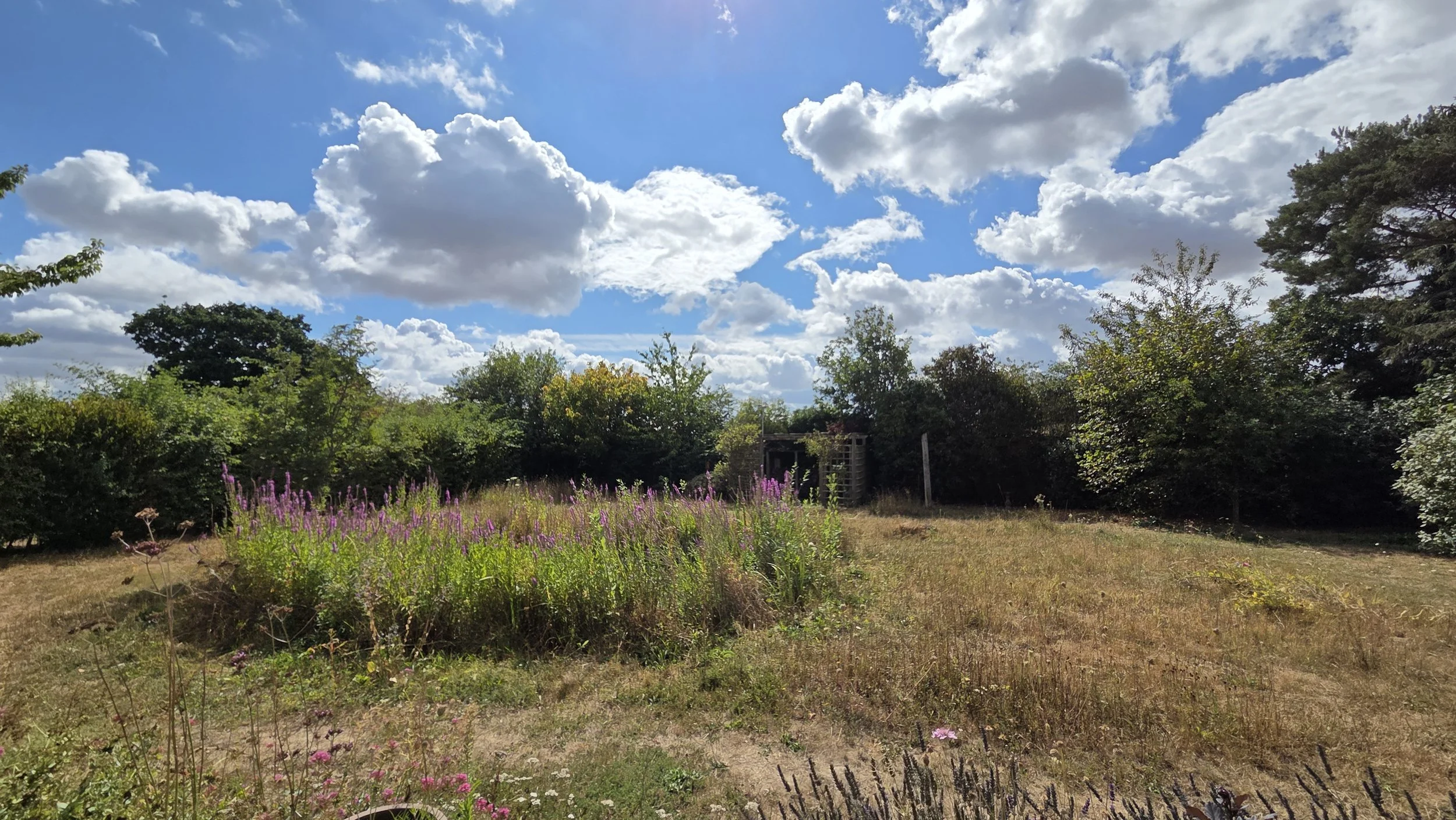
Nar Cottage pond acting as an oasis at the height of the drought (taken 19 August)

Ladybird Ladybird

Ladybirds used to be so common when I was little, but the Harlequin invader has reduced their poulation a lot, so I was very excited to nature journal this native seven-spot Ladybird that I spotted on our patio the other day.

Nature journalling a seven-spot Ladybird

Nature Journalling A Calendar-style Mosaic

For August, my Nature Journaling Group ran a daily thumbnail calendar challenge. I was so chuffed to complete the challenge! It was close, I can tell you. I managed to only skip one day, though for some I used pictures from the day before.

I learned that

  • I should have drawn bigger boxes on a double page spread

  • I should not have inked in the boundaries until the end.😅

Overall I felt

  • Its good for anyone wanting to practice drawing as its low stakes, you have to focus on overall proportions and its easier to conceal (in my case plentiful) mistakes in a small box in a bigger mosaic.

  • It was enjoyble getting out into the garden wondering what to draw that day so ticks the wellbeing box

  • The main drawback for me was that I struggled to incorporate the curiosity element as much as I'd like due to the lack of space.

Kiri’s August 2026 Calender summary

Hello September

I was quite relieved to welcome in September, which started with much cooler temperatures and plenty of rain showers. Its funny how in summer you almost forget what cooler, rainier days are like.

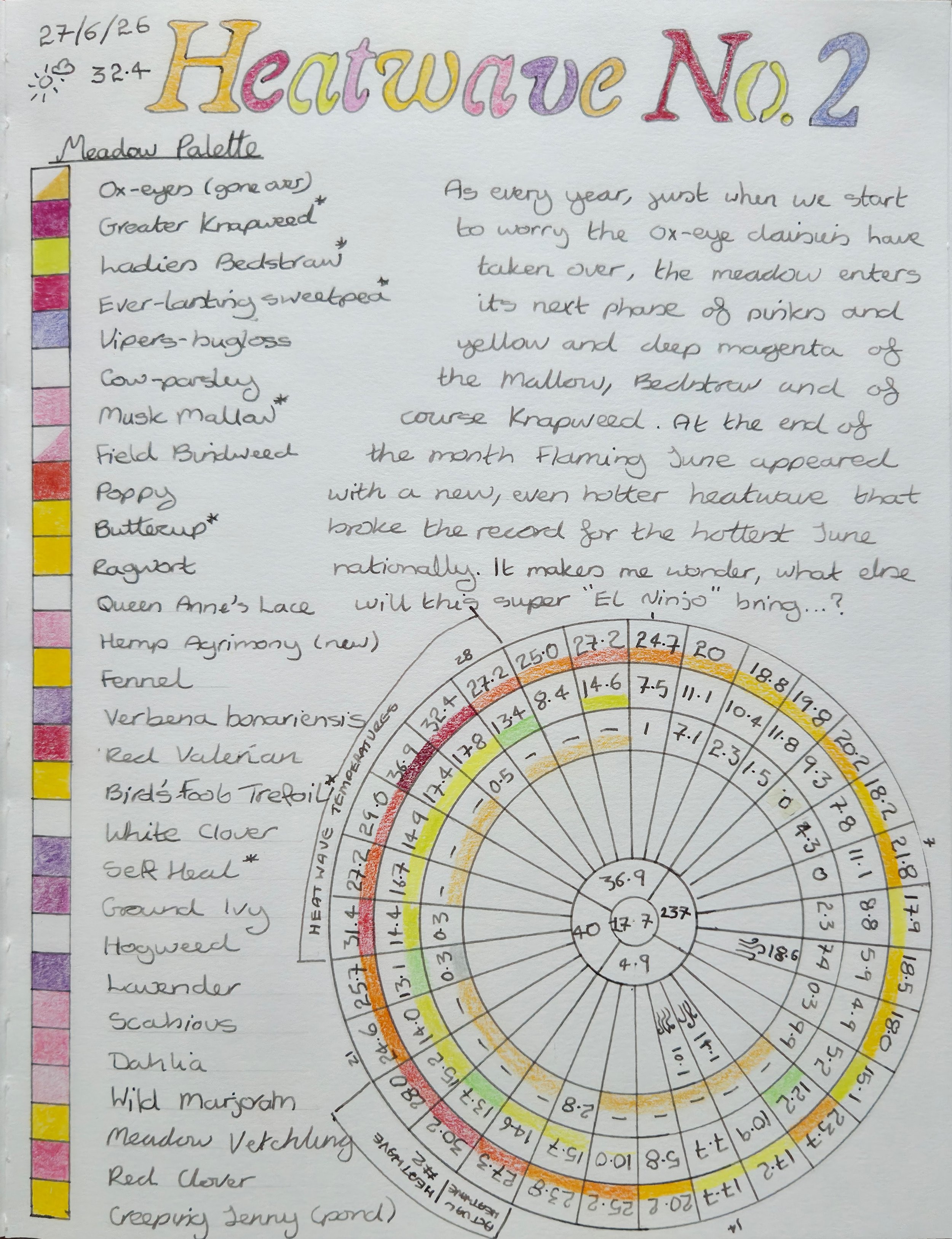
There is now talk of a “super El Niño” bringing autum storms, severe late winter weather and intense heat next summer. We shall see…

Nature journalling the lovely blue skies of a fresher September weather

Female Common Blue Butterfly in the Drought

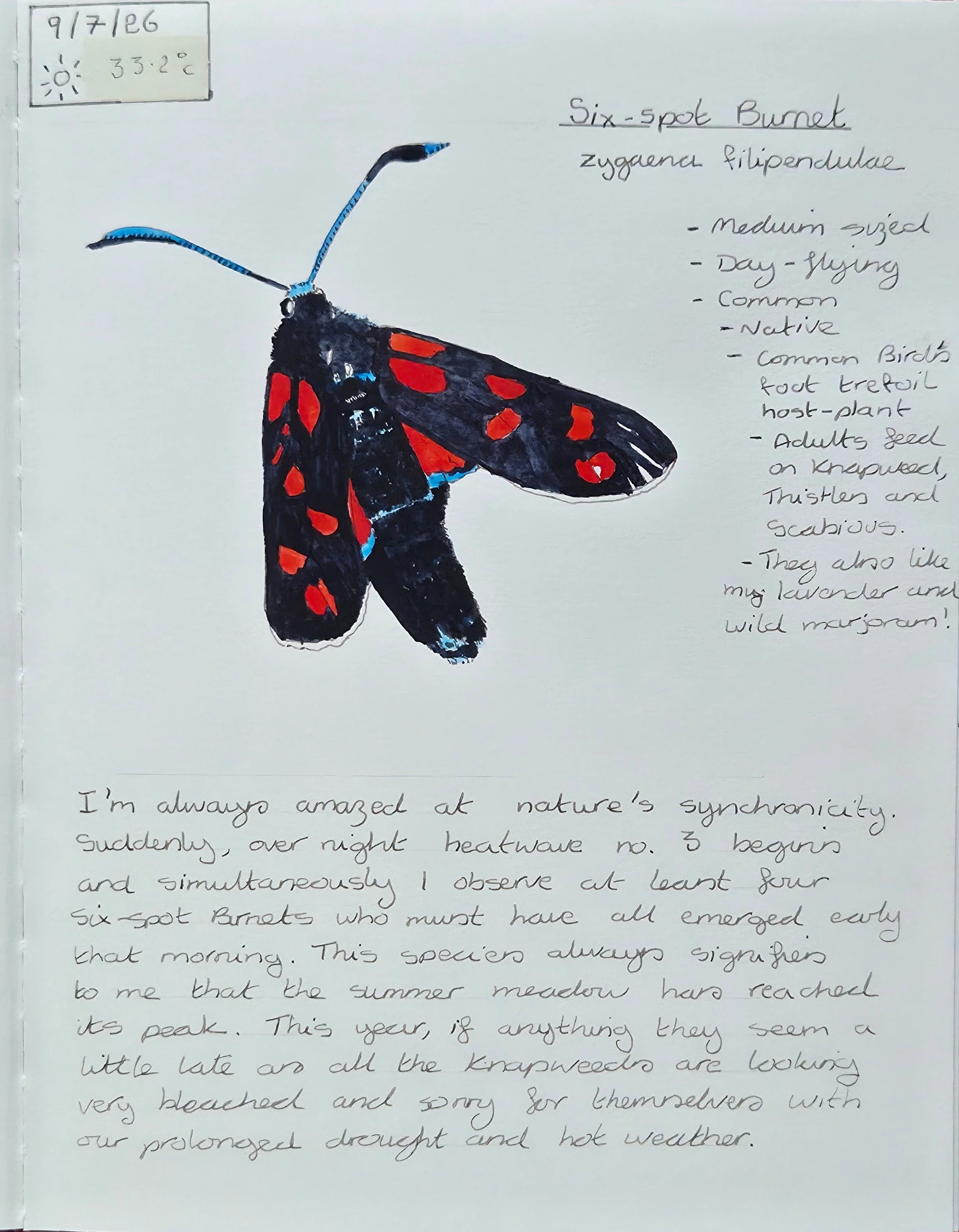
This was one of the most emotive scenes of the summer for me and just had to be nature journalled. I went out for a little recce after the showers cleared and felt very emotional watching this female Common Blue butterfly flutter across the dead grasses desperately trying to find some Bird's Foot Trefoil to lay her eggs on. It was such a bleak sight amidst the parched meadowplants. Hopefully the pond provided an oasis for her. I pray she succeeds and that nature finds a way through.

Partial Solar Eclipse

My journal entry of the partial solar eclipse. I did make a pinhole camera but it was a bit fuzzy (and I experience sensitivity to bright light) so I used the Royal Observatory Greenwich YouTube livestream instead in the end. I took a screenshot every five minutes and then added in my gardens temperature and LUX measures. I used a stencil for all those circle outlines and just hand drew the cutout.

Nature journalling the partial solar eclipse

Grow A Low-mow Flowering Lawn

Low Maintenance Alternatives to Paving, Gravelling or Astroturfing your Lawn

With our busy lives and long commutes, many people dread the idea of spending precious family and leisure time mowing their lawns. So much so that sales of block paving, shingle and artificial grass are soaring. But what is the best option for our health and the environment? Is there a solution that is both low-maintenance and eco-friendly as well as being aesthetic?

Problems with Block Paving

For many years, replacing lawns with paved areas has been a popular way to reduce maintenance and create parking spaces. About 42% of total domestic garden space is paved over according to a 2025 RHS/Gentian study that used AI to analyse 25.8m gardens, equivalent to 4.6% of total UK land area. The Committee on Climate change found that about 11 million square meters of block paving a year was installed in England - 92% of which was non-permeable.

The widespread loss of gardens and green spaces has contributed to increasing drainage and flooding problems, particularly in urban areas, partly because non-porous paving increases rainwater run off by 50%. As climate change has made itself felt and our British weather has become more volatile, flooding has become an increasingly important issue and planning permission is now required to install significant areas of non-permeable paving with no drainage.

Hard landscaping may also negatively impact human well being. Numerous studies have found positive correlations between green spaces and our mental health and negative links with concrete urban environments.

Problems With Synthetic Lawns

Seven and a half million square metres of artificial grass is installed in UK domestic gardens according to the RHS/Gentian study. Artifical grass lawns at first sight seem an attractive option. Cheaper, maintenance free, permeable and kind of natural looking (from a distance). Sales have boomed. Unfortunately on closer inspection artificial lawn/s eco-friendly credentials are overstated.

Artificial lawns are harmful for wildlife, due to habitat loss for burrowing bees, worms and other insects that birds rely on for food. This is a major and growing problem in an increasingly built up urban environment.

Even if recycled they consume fossil fuels to manufacture and many are shipped long distance so have a large carbon footprint. They don't biodegrade yet breakdown eventually polluting the environment.

Potential health concerns have also been raised about the safety of materials used, for example some have been linked to cancer or other serious health risks (see “further reading” section below). So artificial turf doesnt tick the human well being box either.

The good news is that there are some excellent, wildlife-friendly lawn alternatives that are far more attractive than artificial grass, hard landscape or shingle replacements and yet far less effort to maintain than a traditional turf lawn.

What Is a Low-Mow Flower Lawn?

A low-mow flower lawn is a lawn made up of naturally low-growing wildflowers, clovers and other flowering plants that requires far less mowing than a traditional grass lawn. Instead of maintaining a uniform area of closely cut turf, a low-mow lawn creates a diverse, natural-looking carpet of flowers and foliage that can be left to grow for much longer between cuts.

The aim is to combine the practicality of a lawn with the beauty and ecological benefits of a wildflower meadow, but on a scale that is suitable for everyday gardens.

Flowering Lawns as an Alternative to a Grass Lawns

Varity is the spice of life for the ecosystem and a standard turf or grass lawn is a monoculture habitat that provides poor biodiversity. Aside from the odd snail or earthworm for blackbirds or crows to forage it affords little ecological benefit to wildlife. They are also susceptible to drought.

Aesthetically,  aside from being green rather than synthetic, lawns are pretty bland and don't offer much visual stimulation for the human eye. As awareness grows of the flood, environmental and potential health issues surrounding artificial grass lawns, people are starting to look for greener, healthier alternatives to high maintenance traditional lawns without turning their garden into a shingle desert. At the same time wildlife-friendly gardening is growing in popularity.

With a little imagination a dull, patchy lawn can be transformed from a maintenance nightmare into a low maintenance artistic patchwork quilt of low growing wildflowers rich in biodiversity that will support bees, insects and butterflies and the birds that rely on them. Many of the plants possibilities are resilient native or naturalised species that cope with our long dry summer weather, or shade far better than garden centre grass mixes. And if you do need to install a driveway, there are now many sustainable driveway options that work with low-growing flowers.

Benefits of a Low-Mow Flower Lawn

  • Less mowing and maintenance than a conventional grass lawn.

  • Supports pollinators such as bees, butterflies and hoverflies.

  • Adds colour and seasonal interest with flowers throughout the growing season.

  • More drought tolerant than most standard lawn grass mixes.

  • Improves biodiversity by creating habitat and food sources for wildlife.

  • Avoids the environmental drawbacks of paving, gravel and artificial grass.

  • Can thrive in difficult conditions, including dry soils and partial shade.

How to Design A Low Mow Flowering Lawn
Selfheal and White Clover make an attractive, low maintenance wildlife friendly alternative to a traditional plain turf lawn

Probably the star performer for an alternative to turf lawn is white clover, perhaps with a sprinkling of purple-blue selfheal and speedwell dropped in, but there are a whole host of options including the lovely idea of fragrant and herbal flower lawns grown with chamomile, thyme or mint, an innovation first dreamed up by the Elizabethans.

Depending on what flower lawn mix you sow, you may still need just one or two mows on a high setting in spring, but from then on you can leave the sward completely alone through the main summer period, sit back and enjoy the flowers before mowing again once or twice in autumn.

Below is a list some of the best known low growing flower-lawn options to go for sorted by colours, but many other wild flowers will adapt to low growing and flowering height with an early mowing regime. You could even plant in some spring bulbs for extra colour.

Blue / White / Pink Flowers for Flowering Lawns

  • White clover (trifolium repens, native, flowers: white, Jun-Oct)- a star lawn alternative, tough and resilient and simply wonderful for garden bees. It is a caterpillar host plant for 14 moth species, in particular burnet, heath, mother shipton and silver y moths. It has a prolonged flowering season and the leaves of this legume stay green during the height of summer unlike most lawns. Note that its relative red clover grows much taller than the white.

  • Selfheal (prunella vulgaris, native, flowers: blue/purple Jun-Oct ) – a good companion to clower, this semi-evergreen herb with beautiful violet flower spikes can flower well into October. As its name suggest, the herb has a long history of medicinal use for healing wounds.

  • Germander Speedwell (veronica chamaedrys, native, flowers: blue Apr-Jun) A host plant for the heath fritillary butterfly, this variety of speedwell displays bright blue flowers in spring and its name references its historic status as a good luck charm for travellers, to speed them well on their way. Other creeping speedwell varieties include Common Field Speedwell (v. persica) , Grey Field Speedwell (v. polita) Green Field Speedwell (v . agrestis)

  • Ground Ivy (glechoma hederacea, native, flowers: lilac, Mar-Jun) nothing to do with its larger relative it looks a little like bugle and is low growing spring flower oft seen with primroses.

  • Bugle (ajuga reptans, native, flowers: purple Apr-Jun) a member of the mint/dead nettle family with purple flowers on little stalks in spring

  • Yarrow (achillea millefolium, flowers: white to pink, Jun-Oct) a pretty feathery leaved plant in the daisy family with erect flower spikes that flower low with mowing. Great for butterflies and plume moths.

  • Sweet Violet (viola odorata, native, flowers: lilac to deep purple, Mar-May) low growing spring flowers. Sweet violet spreads via rhizomes. Its relative common dog violet flowers a little later.

Yellow / Orange / Red Flowers for Flowering Lawns

Buttercups and speedwell can be low growing alternatives to a turf lawn

  • Bird’s foot trefoil (lotus corniculatus, native, flowers: yellow to orange, May-Sep) – Not everyone’s cup of tea with its vivid yellow “bacon and egss” but this is an excellent moth and butterfly caterpillar host plants used by Common Blue, Green Hairstreak, Dingy Skippers and Clouded Yellow butterflies.

  • Creeping Buttercup (ranunulus repens, native, flowers: yellow, May-Jul) one of Britains native buttercups. Leaves are comparatively large and it does have quite a vigorous creeping habit so be sure you want plenty of glossy yellow flowers before including it in a mix.

  • Daisy (bellis perennis, native, flowers: white-yellow, Apr-Oct) Every perfect flower lawn should have some. No British summer is complete without at least one daisy chain and a game of “she loves me, she loves me not”.

  • Scarlet Pimpernel (anagallis arvensis, native, flowers: red, May-Oct) Made famous by the French rebel, this is a delicate tiny little red flower that opens in the morning when the sun shines and will close up in less clement weather.

  • Dandelion (taraxacum officinale, native, flowers: yellow Apr-Oct), a marmite plant hated by many traditional gardeners for its habit of invading lawns, but a whole field full can be a sight to behold.

  • Cat’s Ear (hypochaeris radicata, native, flowers: yellow May-Oct), often confused with dandelions as it alsow grows as a rosette, but its more delicate and low growing with flowers on spikes and is very popular with meadow butterflies like skippers and meadow browns and gatekeepers.

Fragrant or Herbal Flowers for Flowering Lawns

  • Creeping Thyme (thymus serpyllum, naturalised, flowers:May-Aug ) – a fragrant creeping herb that originated in the mediterranean and was brought to Britain by the Romans.

  • Chamomile (Chamaemelum nobile, native, flowers: Jun-Aug) – another aromatic plant used for tea, this herb became the height of fashion in the Elizabethan era and it was the Elizabethans who first came up with the idea of planting it en masse as a feathery soft lawn fragrant underfoot. A non flowering cultivar is also available.

  • Corsican Mint (Mentha requienii, naturalised, flowers: purple Jul, Aug) – Introduced from Corsica, Sardinia a low growing mint family plant.

Green / Non Flowering Low Growing Lawns For Shade

  • Moss (bryophyta)- overlooked and underrated, particularly good for shady areas, it is a gorgeous rich green and bouncy underfoot.

Consider A Traditional Wildflower Meadow

If you don’t need a low level lawn-like effect and the height of plants is no issue you could even consider a wildflower meadow patch. For the extra effort of an annual cut you could grow a traditional natural grass and wildflower meadow with endless choice of taller flowers. A summer wildflower meadow mix has a cutting regime timed as a hay cut in late summer. Or if you love to see birds in your garden you could consider a dense flower meadow mix for birds and bees. These are designed to be left overwinter for seeds and require a late winter cut around February after the birds have foraged the seedheads.

Abandon your both your lawn mower and the mortar!

So there are a whole host of options that can mean your mower is left to gather dust in the garage most of the year, leaving you free to enjoy your low flowering non turf lawn for its natural beauty and the wildlife species it brings into your garden. Not all lawn alternatives will tolerate heavy footfall, so a little thought research and tailoring is required to find the right option and perfect blend for your area.

But whatever you do –  throw that block paving brochure into the recycling and start growing an exciting low maintenance beautiful space for wildlife!

Red Campion and white Daisies surround the bird bath in the Old Rose Garden at Nar Cottage

Further Reading

Astroturf health and environmental concerns

https://www.telegraph.co.uk/health-fitness/body/are-artificial-sports-pitches-causing-cancer/

https://www.theguardian.com/environment/2016/jul/04/growth-in-artificial-lawns-poses-threat-to-british-wildlife-conservationists-warn

The RHS Gentian Study

https://www.rhs.org.uk/press/releases/first-ever-ai-mapping-of-uk%E2%80%99s-growing-spaces-r-(1)

https://www.theguardian.com/environment/2025/oct/21/nearly-half-of-uk-garden-space-is-paved-over-rhs-study-finds

The Committe on Climate Change’s 2014 Paving Survey Report

https://www.theccc.org.uk/wp-content/uploads/2014/07/7-ASC-paving-survey-report_for-publication.pdf

Research into the effect of green spaces on mental health

http://www.bbc.co.uk/news/science-environment-25682368

Surviving the Drought

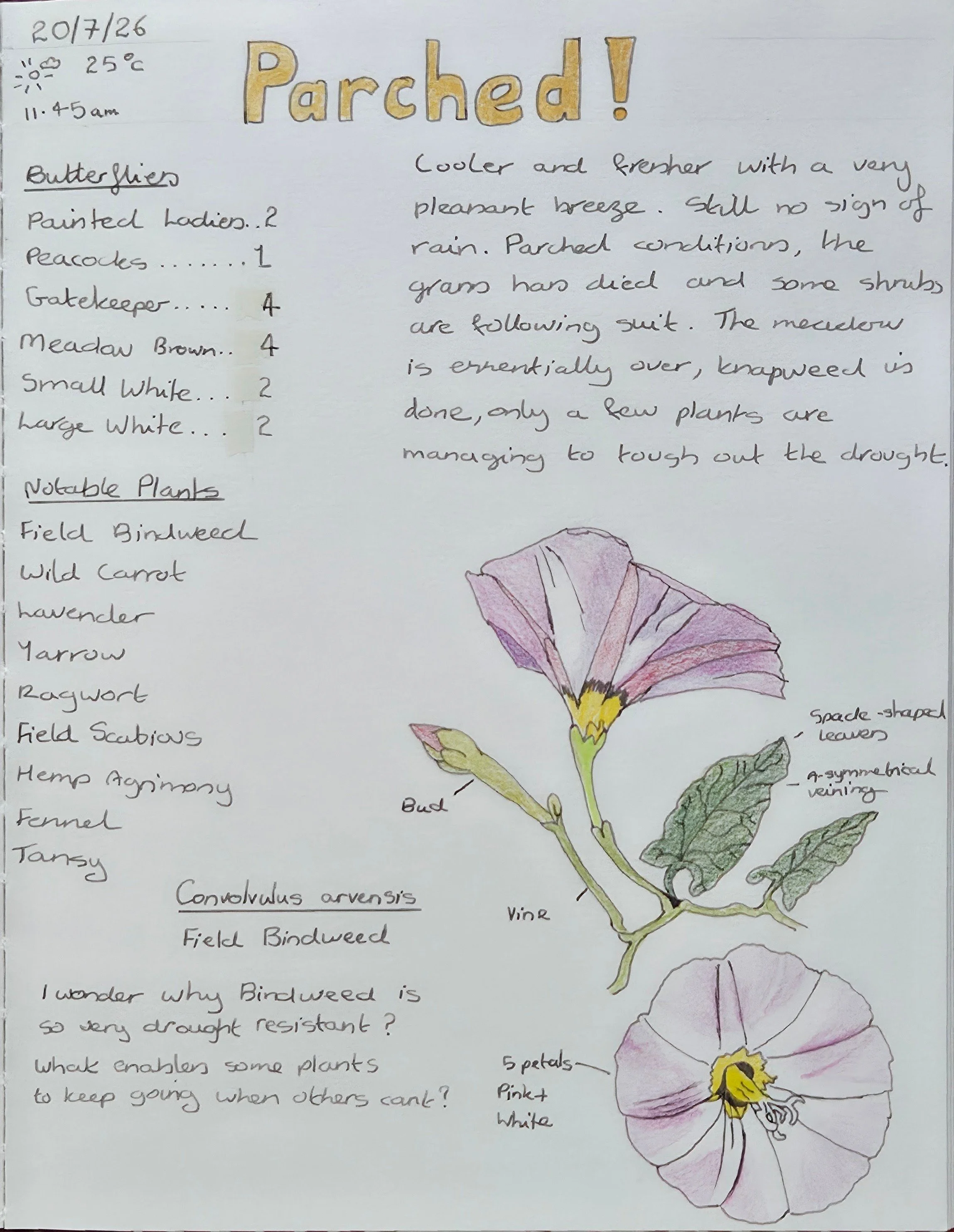
Here its parched in the meadow now, so it will have to come down soon. Field bindweed is my second most hated plant as a gardener after ground elder so I'm not quite sure why I journaled it lol.

I've been wondering about just how is bindweed managing to resist the drought so well relative to other plants. My hypothesis is that it has an extensive and deep underground root network that is helping somehow?

Honeysuckle or Woodbine

Honeysuckle aka Woodbine or Lonicera. I saw it in my front garden, right by my doorstep. While I traced it I noticed the one long stamen on the open flower, and the long tubular shape of the flower.

I picked it because I found the tube shapes interesting and it was just coming into flower. It made me feel proud of my garden and I enjoyed how beautiful the colours and shapes were.

It brought to mind Shakespeare, because I remembered it's mentioned in a few scenes in his work. This turned out to be in A Midsummer Nights Dream which is fitting as its kind of midsummer, temperature-wise at least!

I also wondered why the tubes are so long because it makes it harder for a lot of insects to pollenate it. Only ones with very long tongues can. I guess it just evolved that way to appeal to particular species.