Blog

I blog about nature in the Norfolk countryside and about my wildlife garden. My blog blends digital photos with an analogue nature journal.

Nature journalling blends nature observation and citizen science with a written diariy or art journal to build a deeper connection with nature and cultivate curiosity, creativity and flow.

Ladybird Ladybird

Ladybirds used to be so common when I was little, but the Harlequin invader has reduced their poulation a lot, so I was very excited to nature journal this native seven-spot Ladybird that I spotted on our patio the other day.

Nature journalling a seven-spot Ladybird

Nature Journalling A Calendar-style Mosaic

For August, my Nature Journaling Group ran a daily thumbnail calendar challenge. I was so chuffed to complete the challenge! It was close, I can tell you. I managed to only skip one day, though for some I used pictures from the day before.

I learned that

  • I should have drawn bigger boxes on a double page spread

  • I should not have inked in the boundaries until the end.😅

Overall I felt

  • Its good for anyone wanting to practice drawing as its low stakes, you have to focus on overall proportions and its easier to conceal (in my case plentiful) mistakes in a small box in a bigger mosaic.

  • It was enjoyble getting out into the garden wondering what to draw that day so ticks the wellbeing box

  • The main drawback for me was that I struggled to incorporate the curiosity element as much as I'd like due to the lack of space.

Kiri’s August 2026 Calender summary

Hello September

I was quite relieved to welcome in September, which started with much cooler temperatures and plenty of rain showers. Its funny how in summer you almost forget what cooler, rainier days are like.

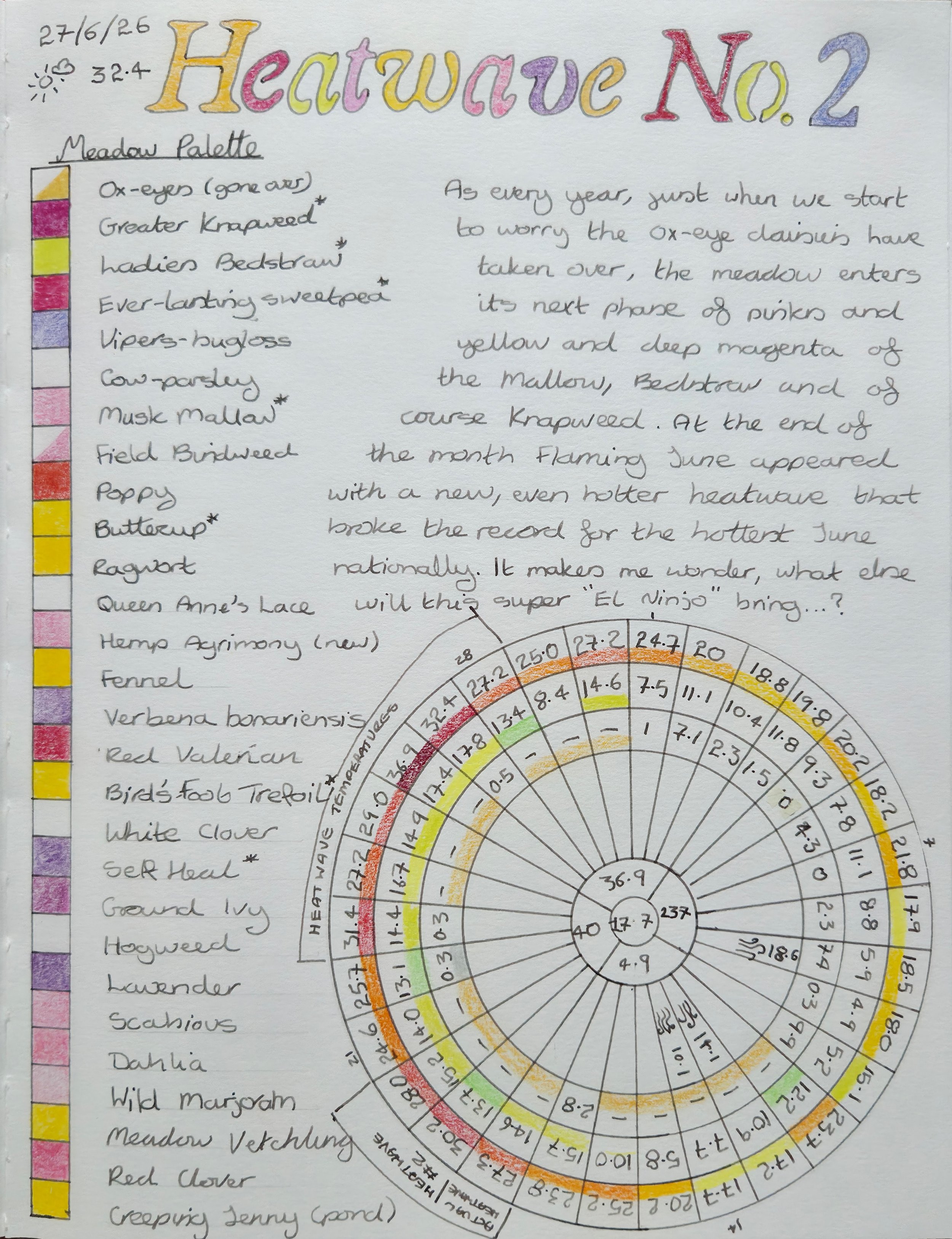
There is now talk of a “super El Niño” bringing autum storms, severe late winter weather and intense heat next summer. We shall see…

Nature journalling the lovely blue skies of a fresher September weather

Female Common Blue Butterfly in the Drought

This was one of the most emotive scenes of the summer for me and just had to be nature journalled. I went out for a little recce after the showers cleared and felt very emotional watching this female Common Blue butterfly flutter across the dead grasses desperately trying to find some Bird's Foot Trefoil to lay her eggs on. It was such a bleak sight amidst the parched meadowplants. Hopefully the pond provided an oasis for her. I pray she succeeds and that nature finds a way through.

Partial Solar Eclipse

My journal entry of the partial solar eclipse. I did make a pinhole camera but it was a bit fuzzy (and I experience sensitivity to bright light) so I used the Royal Observatory Greenwich YouTube livestream instead in the end. I took a screenshot every five minutes and then added in my gardens temperature and LUX measures. I used a stencil for all those circle outlines and just hand drew the cutout.

Nature journalling the partial solar eclipse

Surviving the Drought

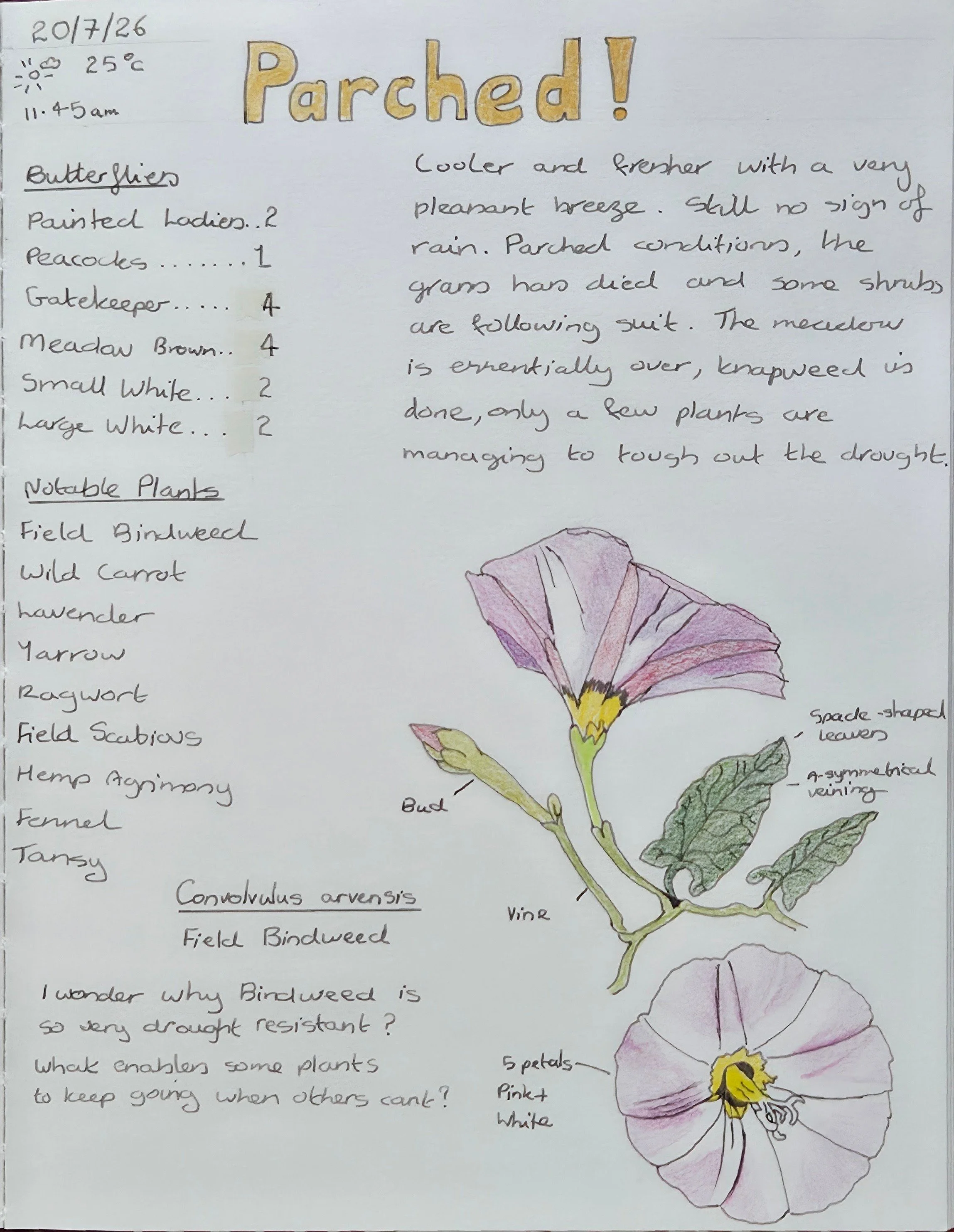
Here its parched in the meadow now, so it will have to come down soon. Field bindweed is my second most hated plant as a gardener after ground elder so I'm not quite sure why I journaled it lol.

I've been wondering about just how is bindweed managing to resist the drought so well relative to other plants. My hypothesis is that it has an extensive and deep underground root network that is helping somehow?

Honeysuckle or Woodbine

Honeysuckle aka Woodbine or Lonicera. I saw it in my front garden, right by my doorstep. While I traced it I noticed the one long stamen on the open flower, and the long tubular shape of the flower.

I picked it because I found the tube shapes interesting and it was just coming into flower. It made me feel proud of my garden and I enjoyed how beautiful the colours and shapes were.

It brought to mind Shakespeare, because I remembered it's mentioned in a few scenes in his work. This turned out to be in A Midsummer Nights Dream which is fitting as its kind of midsummer, temperature-wise at least!

I also wondered why the tubes are so long because it makes it harder for a lot of insects to pollenate it. Only ones with very long tongues can. I guess it just evolved that way to appeal to particular species.