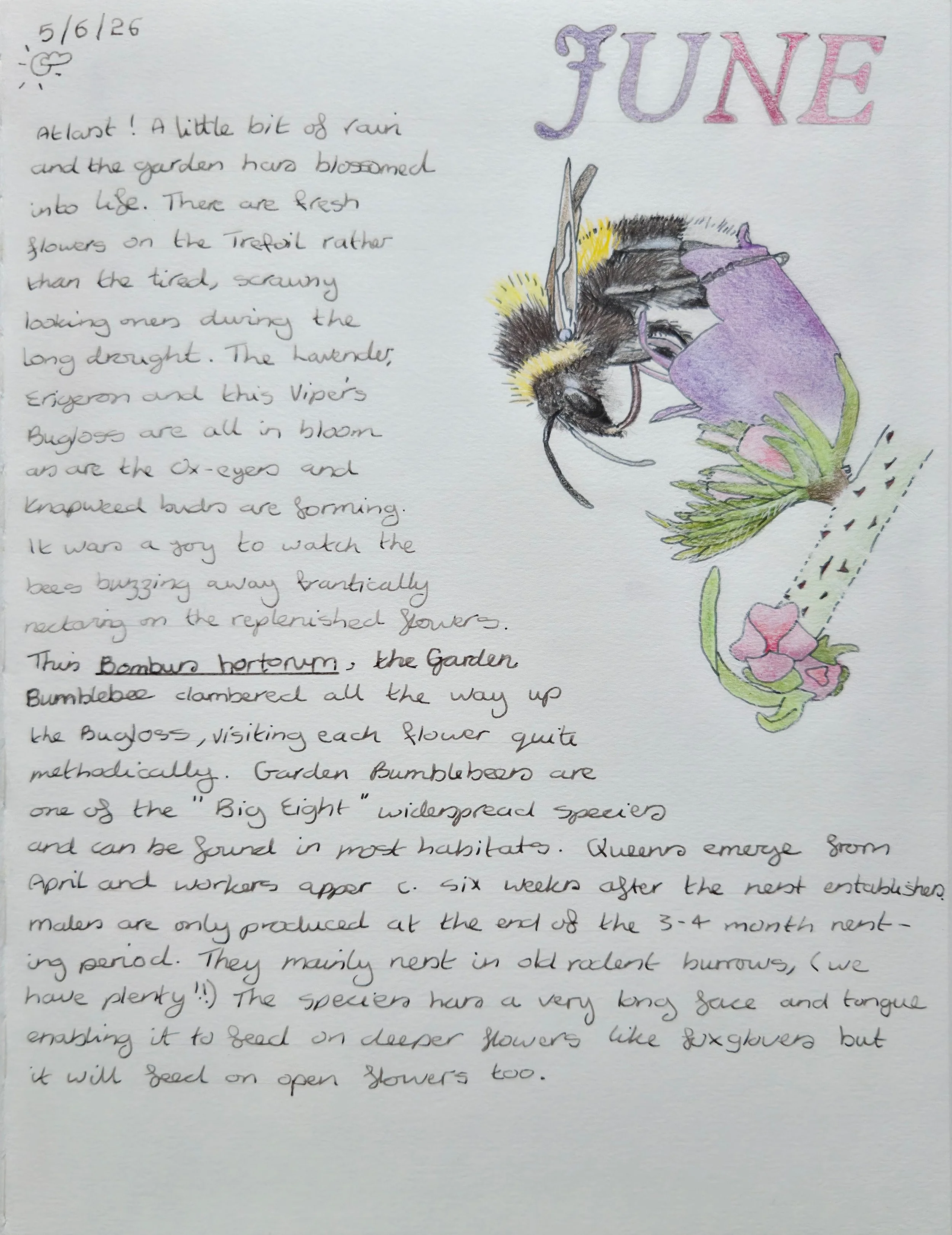
I'm not very good at identifying Bumblebee species so I was pleased to figure out what this one was and read up on it a bit
Blog
I blog about nature in the Norfolk countryside and about my wildlife garden. My blog blends digital photos with an analogue nature journal.
Nature journalling blends nature observation and citizen science with a written diariy or art journal to build a deeper connection with nature and cultivate curiosity, creativity and flow.
A Record Breaking May
The second warmest May on record! And the beginnings of a dry spell with only 15 mm of precipitation recorded for the month.
May Heatwave
Nature journaling the extreme (for UK) weather conditions both heat and drought, which are massively impacting our wildlife garden at the moment.
A Tale Of Two Moths
The hot weather seems to have brought quite a few lepidoptera out. Both of these day flying moths were nectaring on Common Bird's-foot Trefoil, one of their caterpillar host plants. I wonder if they are earlier than usual. I didn't think to add in that data. May try to do so...
Wild Clary
Nature journalling a new discovery for the garden - Salvia verbenaca or Wild Clary.
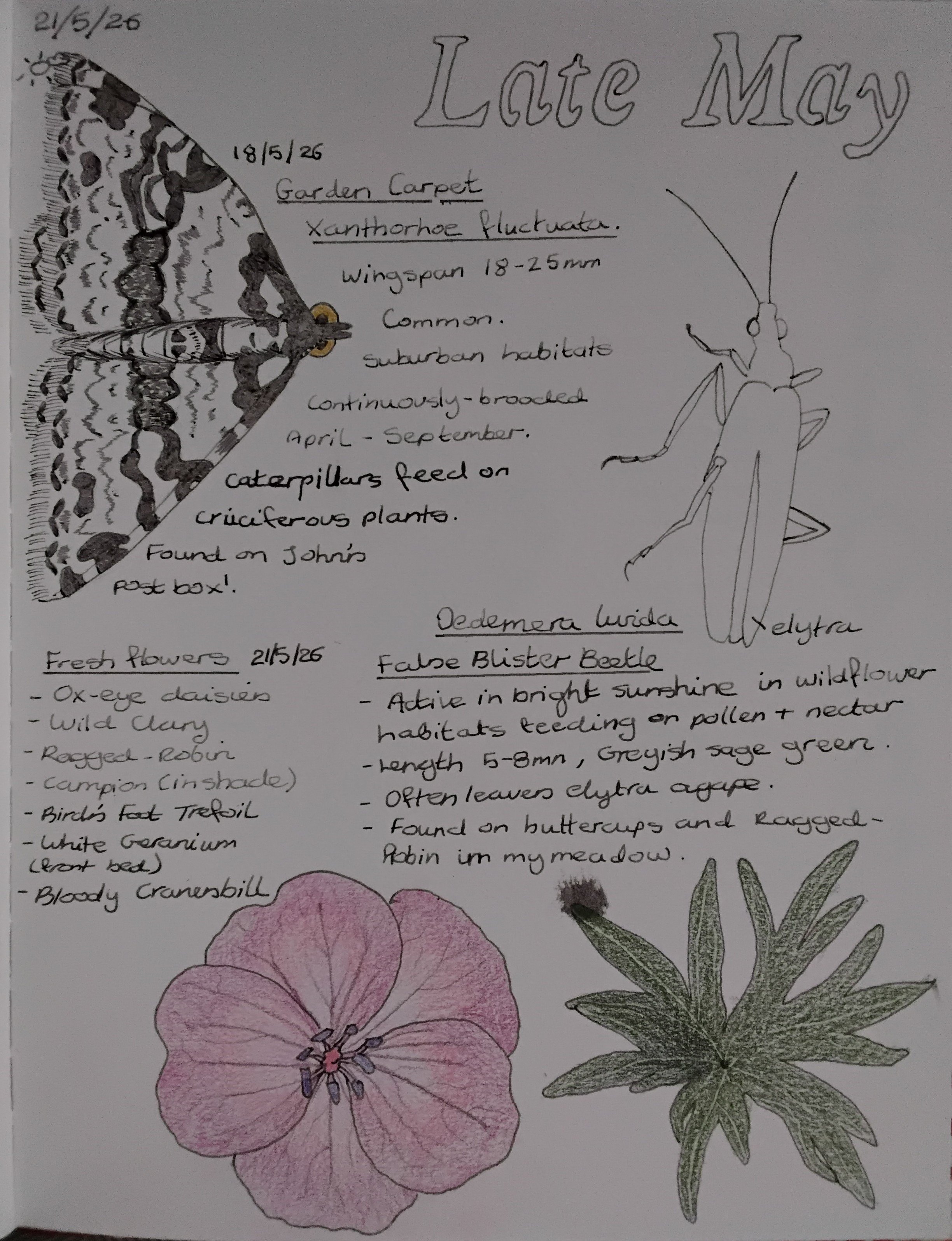
Garden Carpet Moth Late May 2026
My garden safari of 18 May yielded a Garden Carpet moth, False Blister Beetle and Bloody Cranesbill freshly in bloom.
A Painted Lady Year
I wonder if it will be a “Painted Lady” butterfly year…
Weather Wheel April 2026
My monthly phenology wheel of weather station data
Goldcrest in the Winter Cherry
Plenty of flowers but everything is parched and is growing very low in response to the long dry spell / drought. In a first for garden I spotted a Goldcrest foraging amongst the leaves in the Winter Cherry from the sunroom window! Very chufted as it was good sighting and I've only seen them a few times in my life! They are resident and often hang out with Blue tits. Numbers increase in winter due to an influx of Scandinavian migrants.
Large Red Damselfly
John spotted this intermedia male Large Red Damselfly basking on the wall of the house. I wondered if it had emerged recently. Being such early species they really are an auger of spring. It was lovely to see one, especially after being forced to refill the pond, which had dried out amost fully in this strange sunny and dry but cool weather we've beenhaving.
Silver Birch Tree Study
Our oldest Silver Birch that we planted soon after arriving is 15 years old now and c. 25-50ft tall already. They are a very fast growing species. They can play host to over 300 types of insect life so are a pioneer species. Angle Shades and Buff-tipped are among the many moths it hosts.
Butterfly Wings
Butterfly wings are covered in overlapping scales made of chitin. Its stretched like a membrane over a hollow tube framework called verris that carry hemo lymph, air and nerve signals to the wing. Covering the membrane are thousands of tiny scales that overlap like roof shingles. Each scale has long, parallel struts joined to each other by lots of fine ridges creating a lattice.
Purple Bluebells
The Bluebell's hue comes from an anthocyanin, called Delphinidin, that can appear red, purple or blue depending on its chemical environment. PH, light absorption, other flavonoids and metallic ions all affect the final shade we see. Delphinidin has 3 hydroxyl decorations, which shifts the colour towards purple and blue. This marks them as highly visible to pollinators. Colour also changes over time, with the youngest flowers being richest in colour.
April Garden Safari
Peacock Butterflies, Dunnocks and Bird Cherry blossom. I sat out again and spotted a Dunnock busily foraging and flying to the Ivy covered hedge. She must be feeding young in a nest there !. Weather cooler and it turned windy, quite stormy by lunchtime.
Weather Wheel March 2026
An area of high pressure was settled over England for much of the month leading to warmish days and chilly nights. Insanely dry for Spring with just 31mm of rain, the pond nearly dried out!
Winter Flowering Cherry Blossom
Prunus x subhirtella Autumnalis
Produces semi-double white flowers, some tinged with pink intermittently from November to March, opening from deep pink buds. Flowers are sometimes followed by small bitter fruit beloved by birds. It has been awarded the RHS plants for pollinators logo so is presumably good for overwintering and early spring insects. Native to Japan.
A Tiptoe Through The Tulips
Nature journalling Tulips led me to learn a new word, as they have an actinomorphic flower pattern. This means that they are radially symmetrical & divisable by any longtitudinal plane into symmetrical halves
Brimstone Butterflies
I book a trip to Norwich today. It was unseasonably warm and beautifully sunny- the first really lovely springtime day. Along the way I saw not one but 7 Brimstone butterflies! Brimstones have quite large, leaf-shaped wings and hibernate over winter. The males have bright lemon colored wings and the females greenish white-cream wings. Larvae feed on Buckthom and Alder Buckthorn. They always rest with their wings closed. They are widespread as Buckthorn is found on calcareous soils and Alder Buckthorn on moist acid soils. Therefore they are rated as being of “Least Concern" on the GB Red List (2022). From 1976-2019 they've become 22% more abundant but -3% less widely distributed. One possible origin for the word "butterfly" comes from the colour of the male brimstone butterfly.
Roe Deer
John had an incredible sight of a small group of young Roe deer on his dog walk with Rosa. There were 5 deer altogether: 3 male and 2 females. "Capreolus capreolus” have grey-brown winter fur with a white rump & short antlers. Bucks form territory overlapping females and breed in July/August & uses delayed gestation to time birth for May/June vegetation peak.
Cowslips and Currants
John noticed the first cowslip flower out in our wildflower meadow! He also spotted a vivid pink Flowering Current self-sown in our hedge!