Photo Blog

I blog about nature in the Norfolk countryside and about my wildlife garden.

The Beast from the East

Winter definitely had a vicious sting in its tail this February. A "sudden stratospheric warming" over the North Pole, in itself disturbing at this time of year according to climatologists, caused a sharp cooling in lower levels of our atmosphere and via a complex chain of meteorological events reminiscent of the metaphor about the butterfly that flapped its wings on one continent and caused a hurricane on another, brought about heavy snowfall that covered virtually all of the British Isles.

An unusually strong and harsh northeasterly wind stream dubbed the "Beast from the East" triggered a bitter cold snap then swept in heavy snowfall, which was in turn intensified by strong drifting due to the fierce, biting winds that blew continuously for days. 

Here in big sky Norfolk we were heavily exposed to "the Beast" and much of the county was cut off by incredibly large snowdrifts formed by its winds. These, I noticed, were far deeper in areas where the farmers' field verges lacked hedging, a stark reminder of the environmental value of this oft overlooked habitat, which for many years was ripped out to maximise the yield potential of the land in ill-conceived agricultural efficiency drives.

Thankfully many incentives now exist for re-establishment of these vital wildlife corridors and natural windbreaks, so hopefully Norfolk will improve its reputation among hedge layers in years to come. 

"The Beast from the East" blowing snow across an arable field, creating a misty haze
First Snowdrops

In past years, its been February before I've visited Hoe Rough to enjoy the snowdrops there out in force. But this year my first snowdrop sighting at one of my favourite, peaceful nature reserves was much earlier than usual, on the 16th January.

Almost all the snowdrop plants were still quite stubby and offering just the tiniest glimpse of little furled up white buds, there were just 2 or 3 well positioned snowdrop clumps that had opened. So for the first time I captured the very first flush.

In The Snowdrop and the Honeybee I explored the natural history and folklore of one of our earliest flowering wildflowers. Native or not, your heart can't help but lift when you first see Persephone's favourite little flower return from the depths of the underworld to a barren frosty landscape, reminding us that spring may not be as far away as it feels. 

A Purple Streak

The colour purple became my leitmotiv during early July. It is the season of the purple butterflies and therein lies a tale of mystery and obsession...

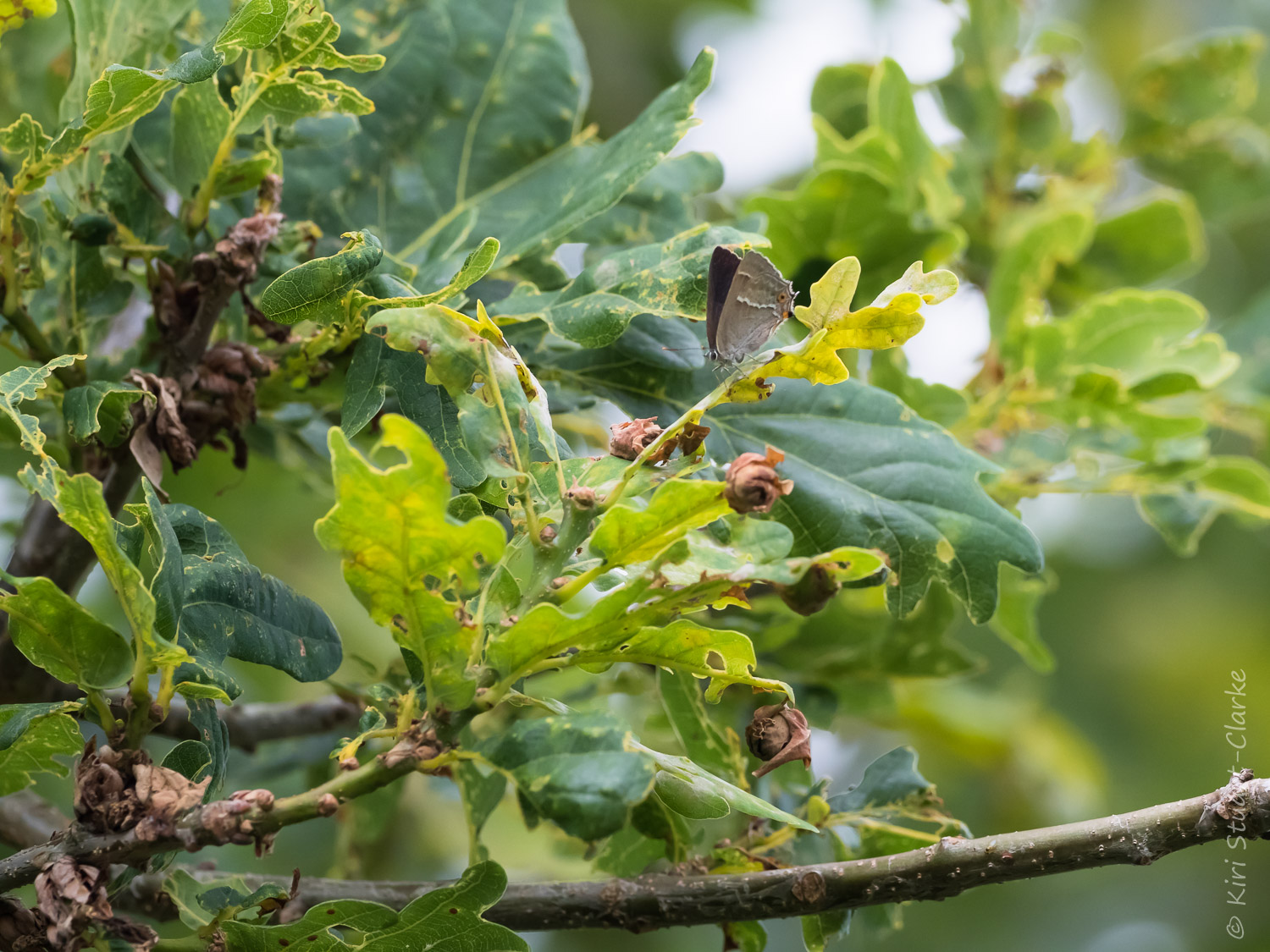
The Oak tree canopy is a habitat for both Purple Emperor and Purple Hairstreak butterflies, which both feed on aphid honeydew

The Oak tree canopy is a habitat for both Purple Emperor and Purple Hairstreak butterflies, which both feed on aphid honeydew

Two very different, yet equally enigmatic, purple butterfly species are on the wing towards the end of June into mid-July. Though very different in fame and stature, both share two things in common: a fondness for the heady heights of mature Oak tree canopies in deciduous woodland and a strong reputation for elusiveness and ability to evade the gaze of even the most determined of butterfly seekers.  

Since being drawn into the world of butterflying I've discovered that, since time immemorial, avid butterfly chasers have gone temporarily a little doolally at this time of year. The hysteria is all over a certain famous, purple-cloaked member of the royal family who is not, officially at any rate, currently resident in Norfolk - the magnificent Purple Emperor. 

Known affectionately to his acolytes as "his Majesty" or sometimes simply "Iris", the Purple Emperor is neither Britain's largest butterfly (our very own Norfolk Swallowtail),  nor the rarest (the once extinct, recently reintroduced Large Blue), nor even the brightest (arguably the Silver-washed Fritillary) so this seemingly bizarre Purple Emperor obsession had been puzzling me for some time. Just what quality is it that bewitches them all? Is it the dramatic colour purple? Their reputed vigorous flight and aggressive behaviour? Or some other mysterious factor altogether ....?

After an inspiring talk by renowned butterfly conservationist and Purple Emperor advocate Matthew Oates at Norfolk Butterfly Conservation's AGM back in 2016, I became intrigued and not a little bewitched myself. In a bid to sate my curiosity and discover the obscure reason for the Purple Emperor's celebrity status for myself, I started planning a field trip to visit his Imperial Majesty's haunts, mature Oak and Sallow woodland rides.

Alas fate was not on my side,  despite attempts to make visits to Fermyn Woods in Northants, Wood Walton Fen in Cambridgeshire or Theberton in Suffolk, life events have intervened and scuppered my plans well and truly for this year. Perhaps Iris is to be my new five year nemesis butterfly, who knows. 

With my ability to range much curtailed, I was crestfallen and deeply disappointed. But there was still the second less famous, but to me equally elusive, purple butterfly to discover: the Purple Hairstreak butterfly, Neozephyrus quercus. And it lives much closer to home.

Although much smaller, the Purple Hairstreak butterfly shares a surprising number of characteristics in common with its larger Imperial cousin. As suggested by its Latin species name "quercus" it too favours mature deciduous oak woodland and so is also highly elusive (and under-reported) as a result to its habit of dwelling up high amongst the tree canopy. There it lives on honeydew produced by aphids and only rarely descends from the "throne" for the odd sip of bramble nectar.

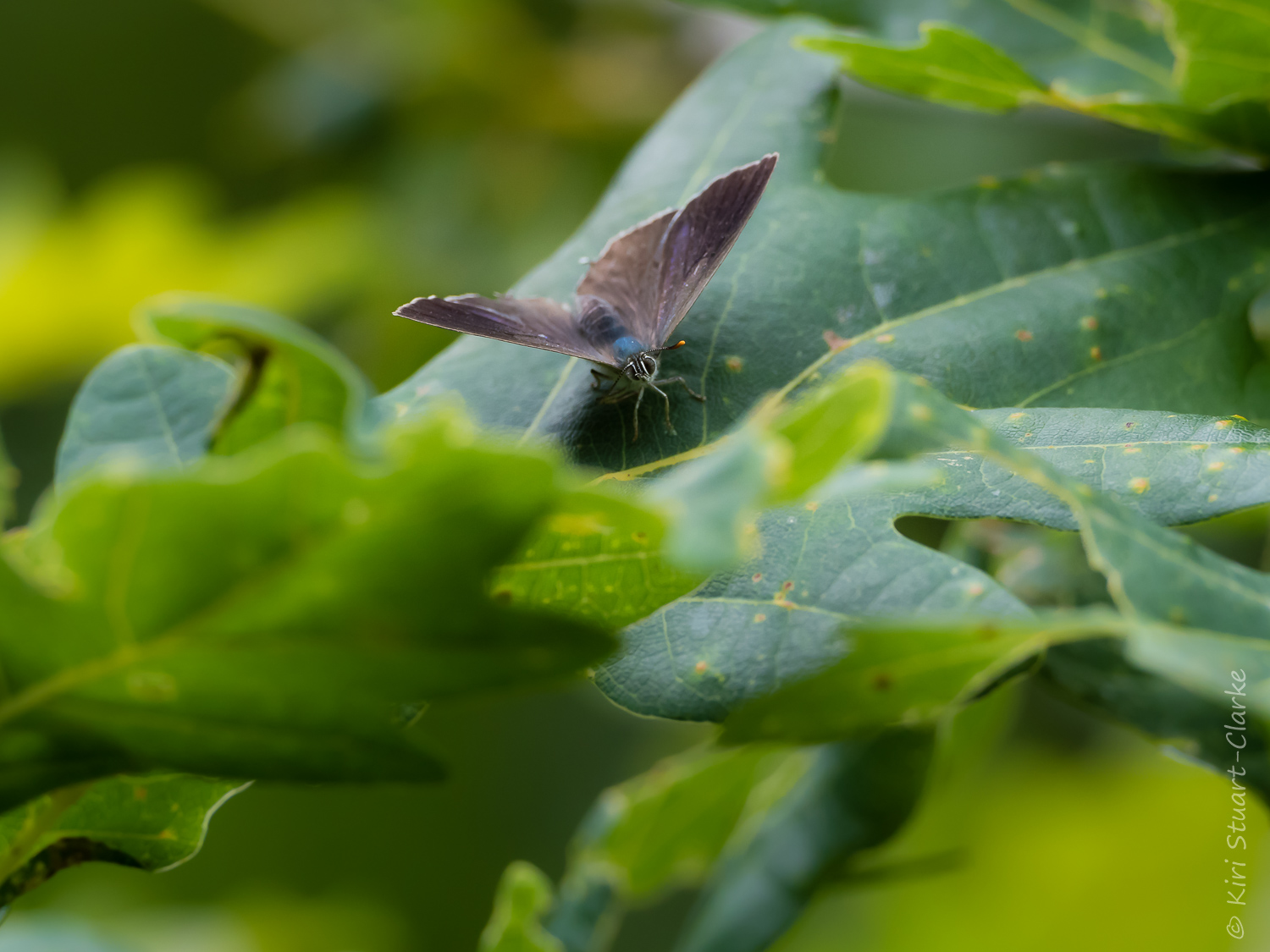
A Purple Hairstreak butterfly perched on an Oak tree leaf near the edge of Syderstone Common, Norfolk

A Purple Hairstreak butterfly perched on an Oak tree leaf near the edge of Syderstone Common, Norfolk

While laid up I did my research thoroughly. Purple Hairstreaks being far more widespread than his majesty, I was able to find some promising local locations in Norfolk, and had in fact already experienced my first brief glimpse of a old faded and tattered Purple Hairstreak on a dog walk at Holkham Hall one August a few years back. I took a punt on a very short run up to the nearby Syderstone Common nature reserve,  on the edge of North Norfolk coastal AONB. Its a large reserve of lowland gorse heathland, an SSSI that is famous for its Natterjack toad population, but not all that much else, in fact a previous visit had left me visually underwhelmed. This time however the reserve was transmuted into a spectacular sea of vivid fuchsia pink willowherb flowers swaying in the gentle breeze.

Essex Skipper butterfly perched on a Rosebay Willowherb flower spike

Essex Skipper butterfly perched on a Rosebay Willowherb flower spike

My fieldcraft skills must have improved somewhat as I was delighted to spot an active Purple Hairstreak quite soon into my visit. There it was, a small grey blob fluttering away right up high in the treetops, initially silhouetted against the cloudy sky. Its flight was erratic and it was hard to keep track as the butterfly flitted amongst the oak treetop and nearby birches in the mature woodland circling this now spectactularly beautiful reserve.

After spotting my Hairstreak's "Master" Oak I stayed for some time, craning my neck to try to spot this diminutive butterfly amongst the oak leaves. Eventually one dropped a little lower and permitted a quick shot before circling up high again in a cluster of nearby Birches.

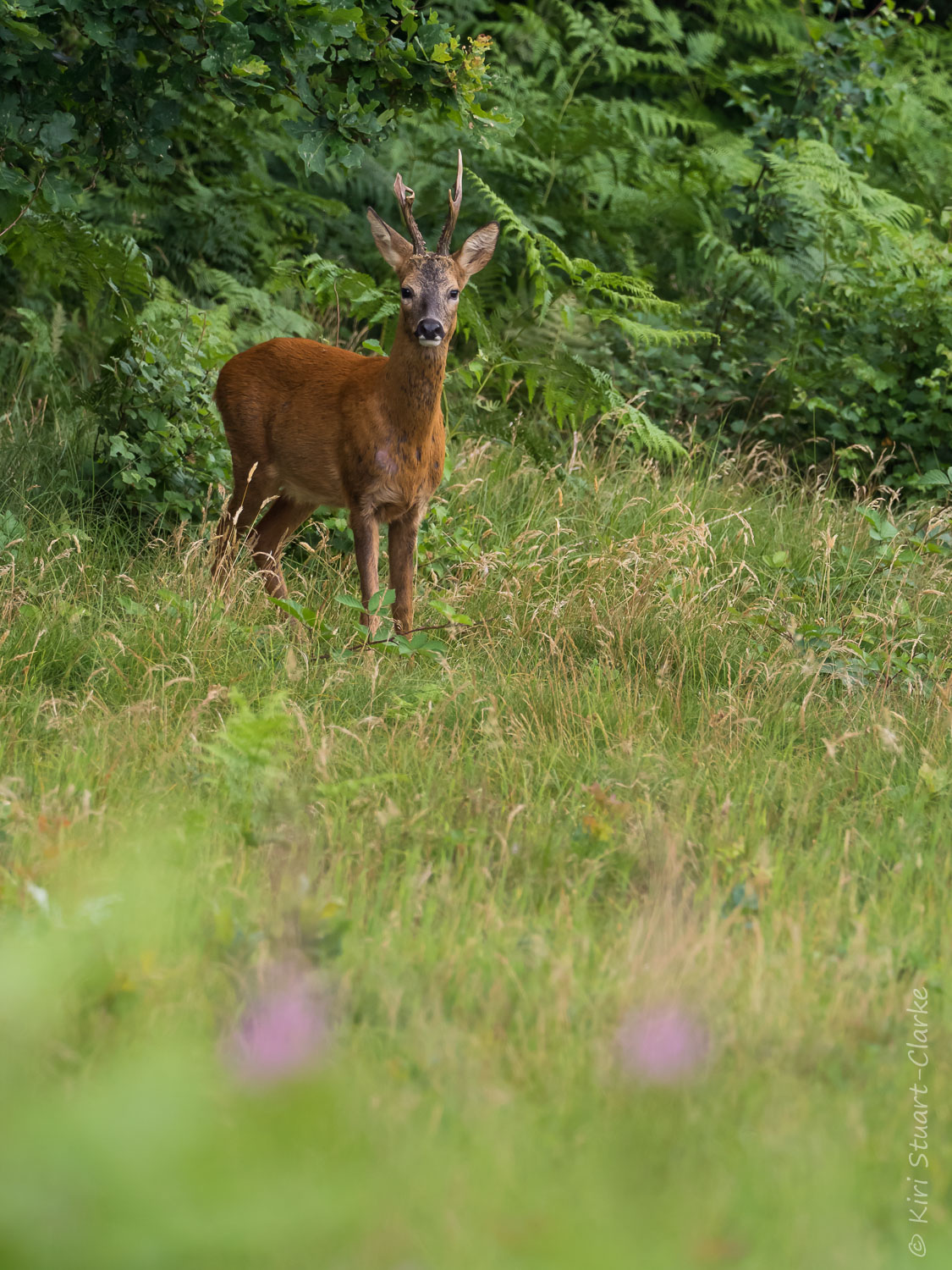
On my way back to the car I spotted a beautiful young buck Roe Deer, who paused, checked me out for a little while then barked at me before trotting off back into the Oak woodland, a beautiful end to my successful visit. Although my sightings had been distant and tantalising, I had bagged my first purple.

Perhaps the abiding memory for me is not so much finally photographing my first purple butterfly, but rather Syderstone Common nature reserve itself, which was a natural habitat at the peak of its mid-summer glory and afforded a sensory firework display of wildflower delight at every turn.

Visually the abundant vibrant pink Rosebay Willowherb flower spires intermingled with creeping carpets of rich yellow Tormentil, while the heady scent of rambling native Honeysuckle hung in the air and bramble in full bloom. Every plant seemed to be alive, swaying in the breeze and dancing with a host of orange Skipper, Ringlet and Meadow Brown butterflies flitting about into the distance as far as the eye could see.

As for purple Royalty... I must now be patient, wait and bide my time till 2018 brings a whole new season and fresh opportunity for his Imperial Highness to ensnare me as subject.

We shall see...

Vivid pink Rosebay Willowherb can be spectactular when in full bloom

Vivid pink Rosebay Willowherb can be spectactular when in full bloom

A young Roe Deer buck on Syderstone Common, Norfolk

A young Roe Deer buck on Syderstone Common, Norfolk

The Skipper and the Rose

I love Skippers, I may have mentioned it before. They are small, cute, furry and very confiding; though that latter characteristic could be more accurately interpreted as territorial and pugnacious. This Large Skipper butterfly (note the black, twirly antennae tips mentioned in my Skipper butterfly identification article) is perched on a humble bramble flower aka Rubus frutiscosus, a member of the romantic Rose (Rosacaea) botanical family and predecessor of modern blackberry cultivars, yet today considered a nuisance weed for most Gardeners due to its vigorous nature.  

This photo serves as a timely reminder that less than glamorous native species can be excellent food sources for both adult butterflies and their caterpillar stage, not to mention other pollinators. I this week's Gardener's World episode, a Welsh research study into Bees favourite nectar source has indicated they will travel further afield to collect pollen from native species in preference to most garden ornamental imports.

According to Chris Manley's British Moths and Butterflies, a bramble bush can serve as a caterpillar host plant for some 35 moths and butterflies, including threatened Grizzled Skipper butterflies as wells as the impressive Scarlet Tiger and Emperor moths.

Perhaps in wildlife terms, not so humble after all.

And yes, if you stop, look closely... close your eyes... inhale the scent..., a rose by any other name remains as sweet.