Blog

I blog about nature in the Norfolk countryside and about my wildlife garden.

Of Yellow Flags and Swallowtails

In an unprecedented week that saw the president of the largest Western Great Power turn his back on the Paris Accord to reduce emissions causing global climate change, I took advantage of ironically hot, sunny weather to visit Strumpshaw Fen RSPB Nature Reserve to see one of the UK's rarest and most threatened butterflies, the British Swallowtail, Papilio machaon britannicus.

British Swallowtail, found only in Norfolk, busy nectaring on native yellow flag iris flowers. Taken from at least 1.4m away on a 300mm 4/3 crop OMD.

British Swallowtail, found only in Norfolk, busy nectaring on native yellow flag iris flowers. Taken from at least 1.4m away on a 300mm 4/3 crop OMD.

The trip was an impromptu reprise of my longstanding attempts to enjoy watching this beautiful endangered Norfolk butterfly, which inspired a earlier blog post on my misadventures over several unsuccessful seasons attempting to find them at various Norfolk nature reserves. Last year, I was even interviewed as part of a BBC OneShow item on the native Swallowtail covering the story of a much more famous lepidopterist's longstanding desire to see them.

This time I was hoping for more than a record shot of this rare and uniquely beautiful butterfly, one of only 6 butterfly species fully protected by UK Law since 1992. With the weather so fair sightings had been good all week so I was daring to hope for some natural behavioural shots of it amongst native fenland flora and habitat, rather than perched upon the pretty Sweet William in the renowned Doctor's flower garden.

After a pleasant chat with a Welsh couple now close to completing a multi year hunt to see all of Britain's 59 native species, I had not  ventured far into the reserve before I enjoyed a wonderful encounter of a freshly emerged Swallowtail first basking low down then fluttering up with its ghostlike flight pattern onto a nearby patch of deep yellow flag iris flowers where it began to nectar frenetically. Then the inevitable happened. It was after all Strumpshaw Fen, a sunny Sunday and Swallowtail peak season: The Lepidopteran papparazzi descended.

Within minutes a host of papparazzi lenses, many far too short for the purpose, had surrounded the poor butterfly and their owners, caught up in the viewfinder, became oblivious to both other nature observers as well as the butterfly's wellbeing, and lens hoods started to encroach within inches of where the butterfly was attempting to feed up, blocking out both light and other people. I gently chaperoned and chastised as best I could to create space for the butterfly to feed and all to take turns to see, before moving on frustrated as the crowd grew too big and closed in again around the butterfly.

I reflected on how , perfectly polite people, behind the viewfinder in focussed pursuit of the perfect digital trophy shot, rapidly became so blinkered and oblivious as to unwittingly block our others and even potentially disturb the rare and protected creature they had come to see. I speculated how many had walked right past numerous other fascinating wildlife and flower species without really stopping to enjoy and appreciate them, in their single-minded mission to capture the one famous "celebrity" species. It prompted me to question the drivers behind my own past mission too, though my long lens's minimum focus always helps ensure a respectful distance.

On a bigger scale, it made me contemplate whether charities' tendency to focus on preserving single "blue chip" star species (using gallons of pesticides in the process) rather than untouched habitats is more a help or a hindrance in our efforts to help environmental recovery.

Thinking back to the Paris Accord. I wonder whether it will ultimately ever really be possible for us, collectively as the human species, to overcome our ingrained survival instinct of self interest to do "the right thing" on a big enough scale in time. I hope so. If not, then perhaps our nation's own beautiful custard-yellow Swallowtail sub-species truly is already the ghost it sometimes appears to be, fluttering amongst it's beloved milkweed and flag iris.
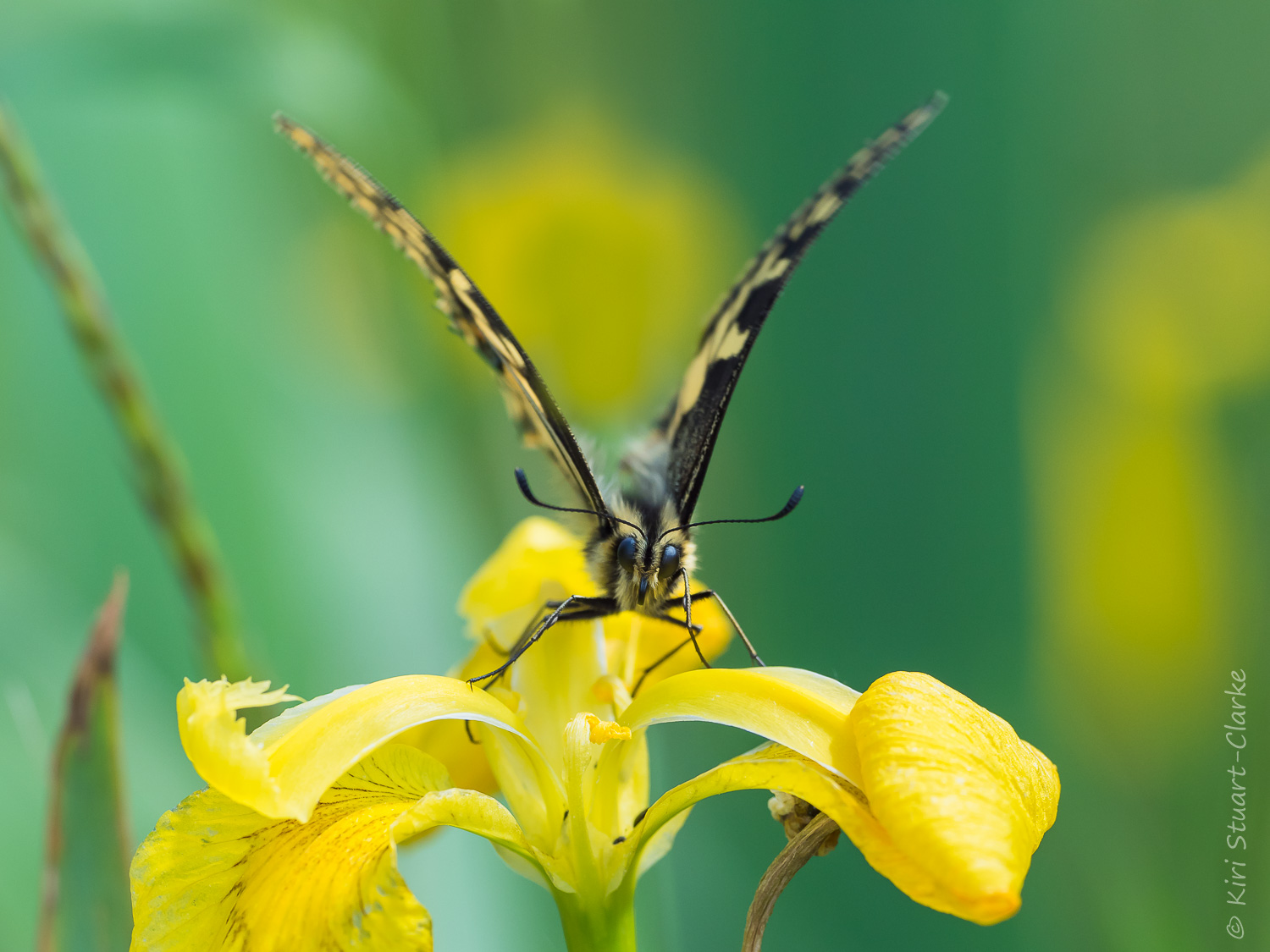
Taking off from a yellow flag iris flower, the British Swallowtail butterfly has been fully protected in UK law since 1992.

Taking off from a yellow flag iris flower, the British Swallowtail butterfly has been fully protected in UK law since 1992.

Clouds on the Mountain

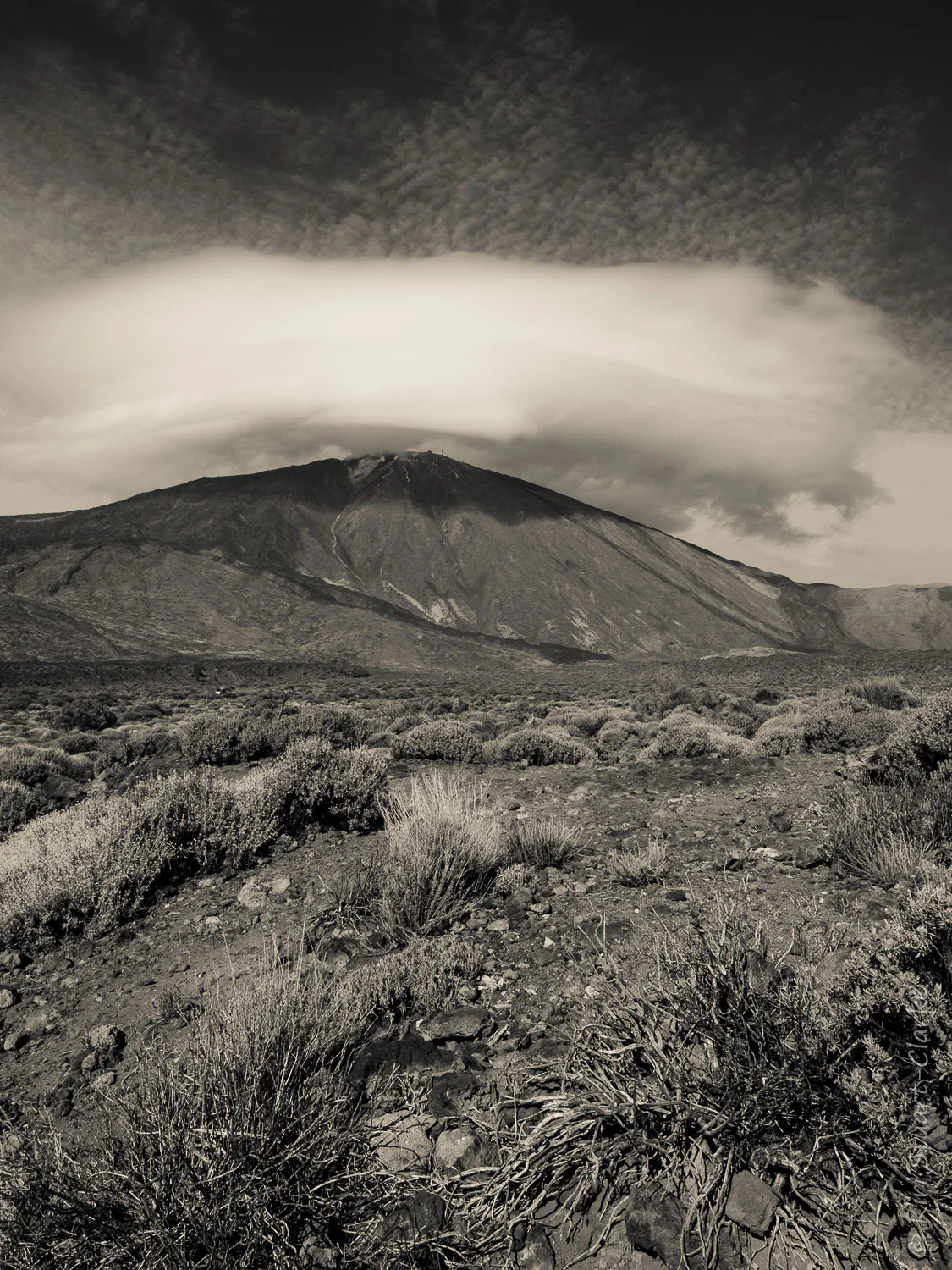
Turbulent cloud formations hover and swirl above Mount Teide. 

I made it to Tenerife after all. The weather in January was markedly cooler than in our previous December visits and characterised by high winds. Neither my camera nor I ventured far, except for our now customary road trip up to the peak of Mount Teide Volcano.

The atmospheric conditions were striking. My favourite photo depicted the powerful, windswept clouds above Pico Viejo, looming over the beautiful yet arid lava plains. In a way the photo is a metaphor for turbulent times, both in personal life and on the global stage, where the weather also feels windswept, and changeable, with a highly uncertain forecast.

If you'd like to see more, I've added a collection of my favourite Tenerife landscape and seascape images and a gallery of the cetaceans that reside off the coast there to my image gallery.

There's No Place Like Home

Its been a "Staycation" holiday week for me, and when you are a little under the weather and even the weather's a little under the weather, then the soft golden light at the end of the day and pretty little signs of autumn in the hedgerows and country lanes always give me a lift.

Here a few shots from an evening stroll along the Nar Valley Way. The local barn owl and muntjac deer made a few appearances too this week, though the owl remains camera shy.

A Late Small Tortoiseshell Summer

At last! Today, a gorgeously golden August bank holiday Monday, I was in Small Tortoiseshell heaven in my back garden with my Olympus 300m lens. With our wildflower meadow newly shorn, I could enjoy wonderful close up views of a late summer brood of Tortoisehell butterflies. They were a beautifully vivid, rich russet-orange colour as they flitted gracefully between the edge of our wildlife pond and our white buddleia, sweeping in to nectar on the pond side water mint. One butterfly cheekily nectared on a water mint flower so close to the water line that it had a narrow escape from becoming dinner with our rather noisy resident frog.

But I’m lucky to be enjoying this sight, because, despite this week's flurry of emergences, today the Butterfly Conservation Society issued a press release about their worrying decline. The Small Tortoisheshell’s population has plummeted by 73% since the 1970s.

Like many butterflies, habitat loss is an issue, but in addition the growing numbers of a parasitic fly, Sturmia bella may also be a contributory factor.

Due to their complex lifecycle, butterflies need caterpillar food plants for their larval stage, as well as nectar from flowers and fruit after they metamorphose into butterflies. Small Tortoiseshells, like several of the nymphalidae butterfly family, use nettles as their caterpillar host plant.

Gardens are increasingly playing a vital role as a habitat in our rapidly changing environment, so if you are a gardener, allowing a generous patch of nettles somewhere sunny at the edge of your garden really could help a struggling butterfly to recover, and when emerging Small Tortoiseshells grace your flower borders, make late summer days in your garden even more beautifully golden.

Of Red Admirals and Queen Anne's Lace

A slightly bizarre blog post title, I know. The connection is that these were the first two subjects that I photographed with the newly launched Olympus 300mm f4.0 pro lens. In old money that gives an effective reach equivalent to some 600mm, a wildlife photographers dream lens. But I wondered if a bokeh was possible, whether the images would really be as sharp as Olympus claimed, and whether the lens might be suitable for long lens macro photography.

Some pretty wild carrot flower seedheads, known as Queen Anne's lace, were my first attempted subject. Immediately I took the lens cap off I had a nasty shock. The lens simply wouldn't focus. The focus point refused to stay still, it bouncedaround lly all over the place. Feeling deflated and not a little seasick from the circular motion  I went to do a little investigation and realised that I needed to upgrade my camera's firmware to support the latest in camera focus stabilisation.

That done. the camera's focus improved dramatically and behaved beautifully again. I finished taking my shot of the wild carrots' dainty seedheads and was pleasantly suprised at the sharpness and bokeh I that was able to achieve.

That still left the question of whether, with the predictably long minimum focus distance of 1.4m, the 300mm lens would be at all suitable for larger less tolerant butterflies and dragonflies, some of my all time favourite macro subjects to photograph.

An obliging red admiral butterfly very much preoccupied with nectaring on my garden privet hedge allowed me to put the lens through its paces. Because of the long reach, it was a little challenging to get the focus spot on and the 1.4m minimum focus distance was, as expected a real constraint, so I am still dreaming of a nice 100mm f4.0 macro with a minimum focal range more like 40cm. Even so I did get some lovely shots rich with detail and could see this lens working nicely with tree top species.

Springtime in der Eifel

Spring has well and truly sprung with a couple of weeks of glorious weather in the UK and the continent. Here a small selection from a short trip to the beautiful Eifel Nationalpark on the German-Belgian border, with lush meadows dripping in springtime wildflowers and vivid dappled green woodland trails bursting with life...

New season's foliage in deciduous woodland on the slopes

Apple tree blossom on a hot sunny circular walk around a 45 thousand year old Meerfelder Maar - a volcanic crater and lake or "Maar".

Wildflowers and butterflies were very similar to those in the UK with cuckoo flower, dandelions, stitchwort and marsh marigolds and dandelions in the downland meadows.

An enticing dappled woodland trail on the Lieserpfad hiking route

Signs of Spring - Insect and Amphibian Emergence

At last...! Some milder days in between the blustery weather, ones when you can really feel the sun on your back. Slowly more signs of spring are present. Insects start to emerge from their overwintering. Though I've yet to photograph my first butterfly of the season (a brimstone on 25th March) I've enjoyed watching out for the early emerging bugs, bees and, that renowned augury of springtime, the first amphibian frogspawn.

My first sign of early spring insect life was this female Minotaur beetle. One of 8 British "Dor" beetles, she emerges in March and roams woodland and pastureland. Despite their size and fearsome looks, Minotaur beetles are herbivores feeding on ruminant dung. After mating she will dig a burrow up to a metre long to lay her eggs.

My second insect sighting was while out gardening. I saw the most gigantic queen buff-tailed bumblebee crash land and nectar furiously on my white crocus. She clambered across our daisy-filled "Meadow Mat" at a surprising rate of knots, looking like she was on a mission, perhaps seeking a nest site to  establish her colony for the season. Sometimes known as the Large earth bumblebee from their latin name Bombus terrestris, Buff-tailed bumblebees are one of the earliest bees to emerge in spring and also among the largest to visit gardens in Europe. 

Looking closely you can see some mites hitching a ride on her thorax. Unlike some mites, they are not parasitic but are in fact harmless detrivores, who survive by living in the bumblebee nest and providing a cleaning service to the colony, feeding on old beeswax and other detritus.

mites-on-bumblebee

And last but not least, frogspawn arrived to our pond on the 26th March this year, 4 days later than last year and in smaller quantities. With a greater amount of protective pond plants established, hopefully the tadpoles will stand a better chance this year against our hungry newt population.

Meet the Skippers - A Photographic Identification Guide to Skipper Butterflies

Ssshh…Don't tell the Essex Skippers, we're in Norfolk!

These charming, vivid orange little butterflies have extended their range recently and seem perfectly happy living two counties further North than their namesake county. At this time of year they can readily be seen "skipping" amongst the hedgerow flowers and meadow grasses of East Anglia alongside their similar looking cousins, the Small Skippers and Large Skippers, sometimes in the company of the larger meadow species such as Meadow Brown, Gatekeeper and Ringlet butterflies.

Norfolk is home to 5 of the UK’s 8 Skipper or Hesperiidae family butterflies. Two, the Dingy Skipper and Grizzled Skipper are distinctive, springtime species largely restricted to sites in the Brecklands. The three orange lookalike butterfly species included in this article are:

  • Essex Skipper

  • Large Skipper

  • Small Skipper

Skipper butterfly identification is a challenge. All three of our most common Skipper butterflies are small, similarly coloured and rather flighty. In fact the Essex Skipper and Small Skipper look so alike that the Essex Skipper was only recognised as a separate butterfly species in 1889. So just how do you tell these three oft-seen Skipper butterfly species apart?

Get a Mug Shot

The surest way to identify and tell the three most common Skipper butterflies apart is to get a photo or good look of the underside of the tips of the butterfly's antennae. The Essex Skipper has very distinctive, inky black antenna underside tips; whereas the similarly sized Small Skipper has orange-brown coloured antennae underside tips. Although the Large Skipper also generally has black tips, its antennae ends are usually more bulbous than those of the Essex and Small Skipper, these two features can’t always be relied on as definitive as they can sometimes vary. The key diagnostic antennae feature to look out for to identify the Large Skipper is that it always has “hooked” or twirly pointed antennae tips, whereas those of both the Essex and Small Skipper are stubby and rounded.

Essex Skipper has black antennae underside tips

Essex Skipper's black antennae tips are rounded or stubby

Small Skipper has orange-brown antennae underside tips

Large Skipper has pointed, twirly antennae tip ends, usually black

Skippers are territorial, living in colonies and can be quite confiding little butterflies when perching or basking. However, as their name suggests, they do have a frustrating habit of zooming vertically off their perch at the slightest movement and skipping off before we get the viewing angle we want, so here are some other perspectives and identification tips.

"Check" out their Wing Markings

The Large Skipper is most readily identifiable from its chequered pattern wing markings. As well as being larger, Large Skipper butterflies appear brighter and more robust than then smaller Essex and Small Skipper butterflies. In contrast both the Small Skipper and Essex Skipper have relatively plain orange wings. Male Small and Essex skippers can be distinguished from each other by their sex bands (see more below). Females are trickier but one other clue to aid separation, though not always a reliable indicator, is that in Essex Skippers sometimes the dark wing edging bleeds up more heavily into the wing veins. Below are two Essex Skipper photos, one with the dark banding radiating into the veins, one without.

Large Skipper's large size and contrasting chequered marking makes it the easiest of the three most common skipper butterflies to identify

Small Skipper basking with wings open

Essex skipper female, sometimes the dark borders radiate along the veins

Large Skipper's chequered wing markings displayed from side on as it drinks nectar with its proboscis

Small Skipper has plain wings when viewed side on

Essex Skipper female basking in evening light

Identifying Skipper Butterflies In Profile

The Large Skipper's chequered pattern is even visible with its wings closed so it should still be readily distinguishable when perching or roosting. Essex and Small Skippers are harder to identify in profile as neither have clear distinguishing marks on their underwings and they are of a very similar size. However, according to Lewington and other field guides, the Essex Skipper's undersides are more straw-coloured than those of the Small Skipper, which may appear more beige or buff. Be especially cautious if using this to distinguish the Essex and Small Skipper, as the look of the underwing can be affected by light conditions and indvidual variations

Essex Skipper has a more straw-coloured underwing than the Small Skipper

Small Skipper has a more buff-coloured underwing (image taken in flat light)

Large Skipper has a checkered pattern visible on its underwings

Use Wing Bands to Identify Male Essex Skippers and Small Skippers

All three male Skipper butterflies have a black gender or scent band line marking on their front wings. This can be particularly helpful in distinguishing an Essex Skipper from a Small Skipper butterfly if you're unable to view them head on. The male Small Skipper has a prominent black gender band that is long and cureved whereas the Essex Skipper's gender band is much less conspicuous, short, straigt and runs parallel to the edge of its forewing.  The male Large Skippers also have very prominant gender bands and at a distance, when fresh from emergence, might even potentially be confused with Gatekeepers due to their vivid orange colour.

Male Small Skipper has a longer, curved, more prominent gender band

Male Essex Skipper has a shorter, straight, inconspicuous sex band that runs parallel to the edge of the wing

A Word of Caution

There is always a degree of individual and regional variation in the markings and colouration on butterflies’ wings and you can find gradual blends between regional variations too. Butterfly markings can also be impacted by the weather while pupating (e.g. extremely hot weather) and fade with age, so sometimes it identification can be a careful process of elimination.

A further peril is only getting a single shot. The camera most definitely can lie, or at least mislead. Sometimes the camera angle or perspective can be deceptive and conceal a sex band or narrow antennae tips. So a diagnostic feature could be present but not necessarily visible. A lack of evidence isnt always evidence of lack, as the saying goes.

This Large Skipper has faint wing markings and its antennae end tips aren’t visible from this camera angle

By way of example, this Skipper was initially mis-identified as a Small Skipper due to a russet brown marking on the end of its antenna and a seeming absence of the twirly hooked end tips.

However a closer inspection after boosting contrast and saturation in the image revealed the very faint presence of the arc of pale checks characteristic of a Large Skipper and a darkened forewing-tip.

It appears that the hooked antennae tips were curling outwards and backwards so from this perspective both were concealed from the camera.

The moral of the story being of course that its always worth getting as many images as you can from as many angles as you can, starting far back at a distance that you know will not disturb the butterfly and moving slowly avoiding sudden jerky movements that will cause the butterfly to skip away. Even if its small in the frame you can always zoom in for ID purposes and discard the image once an ID has been made.

Non Visual Characteristics Can also Eliminate a Suspect

Distribution

Both the Small Skipper and Essex Skipper have expanded their ranges northwards. However, the Essex Skipper is still the more south-easterly of the two species, being seen as far north as the Humber and west to the Severn Estuary. The Small Skipper, like the Large Skipper can be seen even in Wales and Cornwall and as far north as Northumberland recently.

Flight Times

The Large Skipper is the early bird of the three, flying from late May, peaking in mid July and ending in late August. The Small appears next, flying from early June until early September. The Essex Skipper has the narrowest flight period, being seen on the wing from the end of June until the end of August. Bear in mind that flight times can vary significantly by region typically being later further north and also seasonally as butterflies may sometimes take advantage of favourable spring and early summer conditions or respond to adverse conditionas by emerging earlier or later.

Host Plants

All three species are single brooded and feed on various grasses such as Yorkshire-fog (Small Skipper), Creeping Soft-grass (Essex and Small Skippers) and Cock's foot (Large Skipper). Early stage larvae overwinter in the sheaths of long grasses and winter cutting and "tidying" can negatively affect populations. For more information visit www.butterfly-conservation.org

Resources 

My own records and observations in Oxfordshire and Norfolk

Butterfly Conservation Society -  Species Information and Factsheets:

R Lewington - Pocket Guide to the Butterflies of Great Britain and Ireland

All images taken by and © Kiri Stuart-Clarke. All rights reserved

Large Skipper nectaring on a creeping thistle

A Silver-Studded Summer

It seems that summer has been slow to start, but nature can't afford to wait and one of Norfolk's rarest butterflies has taken to the wing pretty much on cue. Silver-studded blue butterflies have one of the most amazing symbiotic lifecycles you could Imagine. Frequenting heathland, they plant their eggs on fresh low lying gorse or heather and depend upon two specific species of black ant, Lasius niger and Lasius alienus to complete their lifecycles. 

Silver-studded blue butterflies live in small colonies. They are a sedentary species, tending to stay local and fly low to the ground. Unlike the blue males, female studded-blue butterflies are brown in colour, but both share the same silvery blue scales in the black spots on the underside of their hind wing for which the butterfly gets its name.

Adults survive only a few days each summer, just long enough to mate and lay eggs. The caterpillars hatch in spring and are and nurtured by the black ants in exchange for a sugary secretion produced by a special gland. The caterpillar pupates underground in the ants nest before emerging as an adult. 

On the Trail of the Swallowtail

Sometimes as a naturalist and photographer, certain subjects remain so stubbornly elusive that they become a bit of a nemesis. Britain's largest and most iconic species "papilio machaon britannicus", our very own British swallowtail, was one such unlucky species for me. So much so, that it took me some five years to achieve my first photograph of this amazingly beautiful butterfly.

Our British swallowtail butterfly is actually a subspecies of the European strain that has adapted itself to use the delicate and somewhat sensitive fenland plant milk parsley as its caterpillar host plant. Once comparatively widespread in the south east, its range is now restricted to the Norfolk fens.

Many of you will know that butterflies are one of my favourite wildlife species and I'm a passionate supporter of the Butterfly Conservation Society, which does a great job of raising awareness about the threats to this beautiful animal. Though scarce, I live in Norfolk, the same county that this elusive butterfly calls home. So just how hard can it really be to see one?

Well timing is everything they say. The swallowtail is single brooded and has a relatively short flight period, from around mid May to mid June. If you add to that the need for reasonably clement weather, the window of opportunity is fairly narrow. In my defence, years one and two of my five year wash out were before I had relocated to live in Norfolk.

My natural history and local knowledge was still comparatively limited, and I was restricted solely to weekend trips to Norfolk targeted for the start of its flight period. These were planned using field guides, with the sole aim of seeing this amazing butterfly. Sadly that was just as we entered that phase where our winters were harsh, spring arrived late and the weather utterly uncooperative. Thus for two years in a row, bleak grey skies, cold temperatures and high winds put the kaibosh on my naive optimism and my target remained stubbornly and mysteriously elusive...

Year three and I relocated to Norfolk, surely now I would just stumble across one right? Cue multiple trips to Hickling, How Hill and Strumpshaw, all known Swallowtail hotspots over the course of the next three years. Yet these attempts attempts to witness the beauty of this butterfly were always ill-fated. I forget how many times I met people and heard them say frustratingly, "oh there was one just down that path there " . Of course said Swallowtail invariably had vanished by the time I reached the spot, for all my luck, the Swallowtail might have been a capricious sprite from the cast of Shakespeare's a midsummer's nights dream.

Last year life simply overtook me. My hunt started far too late in the season for success. So this year, I was determined, was to be the year of the Swallowtail. Come what may I was determined, I would find this iconic, awe-inspiring butterfly, no matter what!

Spring this year was again cool and I was nervous, conditions were far from auspicious for a prompt emergence or a bountiful butterfly season in Norfolk.

A visit to RSPB Strumpshaw Fen offered me my first fleeting, tantalising glimpse, but my bad luck struck again! Just as I arrived I glimpsed a large custard yellow butterfly swoop in...and it was, yes! ,,,.a swallowtail swooping in and aiming to land to nectar on white violet flowers at the main entrance. But even as I approached it was immediately spooked by an over-enthusiastic visitor waving his camera at it! This tourist seemed to be the incarnation of my Swallowtail nemesis, the butterfly equivalent of the "Man from Porlock" and opportunity lost. Assured by staff that they often returned, I stood stationary, sentinel-like for over an hour. Eventually a friendly gentlemen suggested another spot where he'd seen them "only a few hours before" - so off I trooped, yet to no avail. Another Swallowtail near miss, thwarted by mischance or fate, who knew and I finally started to see the funny side of it all.

Perhaps my resignation and acceptance swung it and the gods took pity on me. I had only one last day left of even remotely suitable weather between what were quite vicious storm showers and off I went one last time on my Swallowtail mission.

Back at Strumpshaw, now a familiar friend of a reserve, I ambled around the areas I'd been shown over the years, my jacket still done up against a nippy morning chill. Mercifully, the weather stubbornly refused to close in as forecast. I dawdled up and down the footpaths for about an hour, amidst cloudy intervals and cool, breezy conditions. Eventually, quite suddenly the sun won its battle against the grey and the temperature rose sharply.

Swallowtails nectar on many pink and purple flowers including red campion, as well as yellow flag iris

Suddenly, to my immense surprise and joy, an immaculate, freshly emerged swallowtail materialised from the tree canopy above, landing to nectar on some wild red campion blossoms, bouncing from flower to flower. I was taken aback by the  sheer size and presence of this impressive, majestic almost magical, butterfly with its vibrant colours and bird-sized wingspan.

At last, this bird-sized stunningly beautiful butterfly posed for me, even basking, its impressive wingspread outstretched whenever the sun vanished behind the lingering cloud to warm itself up in the spring breeze.

My five year long mission was accomplished.

This freshly emerged swallowtail basked with its wings open during cloudy intervals