Photo Blog

I love observing nature through the changing seasons both in my Norfolk wildlife garden and the surrounding countryside. I blog about wildlife gardening as well as about Norfolk butterflies, wildflowers and other flora and fauna that I come across. Bookmark my Norfolk nature photo blog to keep up to date with my photographic adventures.

There's No Place Like Home

Its been a "Staycation" holiday week for me, and when you are a little under the weather and even the weather's a little under the weather, then the soft golden light at the end of the day and pretty little signs of autumn in the hedgerows and country lanes always give me a lift.

Here a few shots from an evening stroll along the Nar Valley Way. The local barn owl and muntjac deer made a few appearances too this week, though the owl remains camera shy.

A Late Small Tortoiseshell Summer

At last! Today, a gorgeously golden August bank holiday Monday, I was in Small Tortoiseshell heaven in my back garden with my Olympus 300m lens. With our wildflower meadow newly shorn, I could enjoy wonderful close up views of a late summer brood of Tortoisehell butterflies. They were a beautifully vivid, rich russet-orange colour as they flitted gracefully between the edge of our wildlife pond and our white buddleia, sweeping in to nectar on the pond side water mint. One butterfly cheekily nectared on a water mint flower so close to the water line that it had a narrow escape from becoming dinner with our rather noisy resident frog.

But I’m lucky to be enjoying this sight, because, despite this week's flurry of emergences, today the Butterfly Conservation Society issued a press release about their worrying decline. The Small Tortoisheshell’s population has plummeted by 73% since the 1970s.

Like many butterflies, habitat loss is an issue, but in addition the growing numbers of a parasitic fly, Sturmia bella may also be a contributory factor.

Due to their complex lifecycle, butterflies need caterpillar food plants for their larval stage, as well as nectar from flowers and fruit after they metamorphose into butterflies. Small Tortoiseshells, like several of the nymphalidae butterfly family, use nettles as their caterpillar host plant.

Gardens are increasingly playing a vital role as a habitat in our rapidly changing environment, so if you are a gardener, allowing a generous patch of nettles somewhere sunny at the edge of your garden really could help a struggling butterfly to recover, and when emerging Small Tortoiseshells grace your flower borders, make late summer days in your garden even more beautifully golden.

Silver Sea Lavender Skies

Sometimes muted grey skies can be a blessing in disguise, as was the case with this shot. High contrast full summer light can be tricky to contend with during the day. This soft pastel palette of sea lavender in Holkham bay was only possible thanks to some heavy leaden grey cloud skies creating soft even light conditions. Taken with the new Olympus 300mm pro-lens.

Springtime in der Eifel

Spring has well and truly sprung with a couple of weeks of glorious weather in the UK and the continent. Here a small selection from a short trip to the beautiful Eifel Nationalpark on the German-Belgian border, with lush meadows dripping in springtime wildflowers and vivid dappled green woodland trails bursting with life...

New season's foliage in deciduous woodland on the slopes

Apple tree blossom on a hot sunny circular walk around a 45 thousand year old Meerfelder Maar - a volcanic crater and lake or "Maar".

Wildflowers and butterflies were very similar to those in the UK with cuckoo flower, dandelions, stitchwort and marsh marigolds and dandelions in the downland meadows.

An enticing dappled woodland trail on the Lieserpfad hiking route

In The Bleak Midwinter....

Its January, normally the time of Jack Frost and blankets of white, mittens and snowballs...well not tis year!

El Nino seems to have put paid to all that white stuff in East Anglia for 2016 , which could be one of the warmest (not to mention wettest and windiest!) on record in the UK. 

The mild weather also has our plantlife well and truly fooled, with primroses and daffodils nodding alongside snowdrops and aconites. So, instead of a classic snowy winter's scene, this January's blog is of a winter's walk amongst the silver birch catkins at Narborough.

Nodding catkins, a harbinger of spring still some months away

Evergreen bramble leaves are a welcome sight of green

Winter light has a wonderful glow

A rare blue sky day amidst the brutal sou'westerlies of winter 2016

Mild winters can cause unusual numbers of pests

Lone Pine in Lava Field

I was spoilt for choice in picking December's photo of the month, having enjoyed a repeat festive trip to Cologne Weihnachts Markt (blog followers, the piano man was still there playing) a beautiful walk at Cley beach as well as having a multitude of landscape photos from my second visit to Los Gigantes in Tenerife. Yet it was this simple, stark shot of a lone pine tree in a blasted lava landscape on the flanks of Mount Teide volcano that has stayed with me.

Perhaps because it simultaneously represents both the fragility of nature and its stubborn resilience. The barren lava flow depicts the sheer magnitude of devastation that nature can unleash - despite Man's hubris these are forces well beyond the power of humankind to influence or control. Yet in that small, vibrant splash of green the image also contains a germ of hope. However bleak the landscape may become, nature soon starts to fight back; this young little pine tree is the first tree in a slow process of recolonisation of the lava-blasted the volcanic foothills centuries after the violent 1798 eruption that created this strange landscape.

Hunstanton Sundog

Parhelion at Sunset - Hunstanton, Norfolk

On my last landscape trip I witnessed a truly beautiful natural phenomenon. As I arrived at Hunstanton beach and gazed at the sunset it appeared as if there were not one but two setting suns in the sky, both positioned low on the horizon, the second with a hint of a rainbow-hued glimmer in an arc shape. This optical atmospheric effect is called a parhelion, or sun dog and is one of many types of ice halos  caused by the refraction and reflection of sunlight through small ice crystals high up in the atmosphere. I discovered that the atmospheric conditions had also created the faint sun pillar in the photograph, which is not  caused by a vertical ray of light at all, but by the glinting of many tiny hexagonal-shaped plate ice crystals, the same shape of ice crystals that create sundogs. 

Many thanks to atmospheric optics expert Les Cowley for his assistance in identifying the specific type of atmospheric optical effects I observed and photographed in this image and to the clear scientific explanations provided by his website of the many unusual atmospheric phenomenon  that can be observed by day and night. Click here to see a scientific diagram explaining the optical effects in my image

A faint whisper of spring...

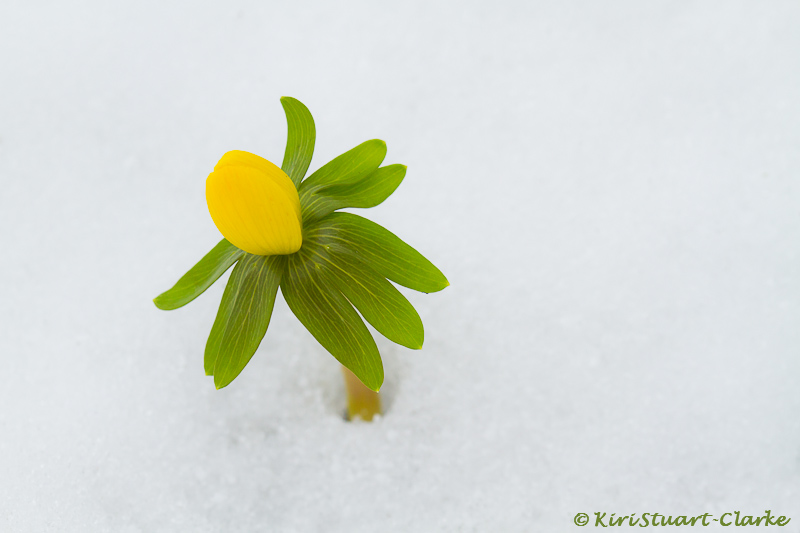
Winter Aconite, Eranthis Hyemalis Peeping Through Snow

Winter Aconite, Eranthis Hyemalis Peeping Through Snow

Even though we have had thick snow on the ground for a week and a half now there are still faint augurs of spring all around us if you look hard enough. And the sight of this bright yellow Winter Aconite, Eranthis Hyemalis amidst the snow brought me joy.

Gardening Value of Winter Aconite

This delicate, yet plucky little flower is one of the very first plants to flower in the new year; peeking its cheery buttercup-like head bravely out even when it has to tunnel through thick snow to do so, often while the more famously celebrated Snowdrops are still little timid shoots barely starting to make an appearance. As well as resembling a Buttercup, Winter Aconites are also related to them being in the Ranunculaceae or Buttercup family.

Winiter Aconites are very versatile adding bright, vibrant colour and interest in the wildllife garden at a barren time. They can work well both in an informal wooodland edge setting, along a hedge or more formally lining a border or pathway. It is very effective for winter ground cover and tubours spread quickly in a carpet-like fashion, not unlike Snowdrops. Aconites will thrive in part or full sun in fertile, moist, humus-rich soil.

Wildlife Value of Winter Aconite

Being such a seasonal pioneer, its early flowering habit makes Winter Aconite a blessing for wildlife, providing an invaluable nectar source for early foraging bees, flies, beetles and other insects, with its cup-shaped flowers affording easy access. It’s a must-have plant in any wildlife garden. As with all Ranunculaceae Winter Aconites are toxic plants to mammals and so resistant to grazing by herbivores such as Rabbits or Deer or Field Mice.

Plant Folklore of Winter Aconite

Eranthis Hyemals is a non-native perennial, originating in Southern Europe and the Balkans. It was first introduced in the 16th Century (1596), became fashionable in 18th century landscape gardens including those of Lancelot “Capability brown”. This encouraged naturalisation, with it first being recorded in the wild in 1838. Winter Aconites can be found in many parks and woodlands across England particularly South of the Midlands and in the East of England.

Early herbalist John Gerard listed the Winter Aconite as "Winter Wolfes-bane or Small Yellow Wolfes-bane” in his 1636 “Herbal, Historie of Plants” and incorrectly placed it in the Aconitum family within Ranunculaceae, which includes Wolfsbane, Aconitum napellus. He described Winter Aconite thus: “whole leaves come forth of the ground in the dead time of winter, many times bearing the snow on the heads of his leaves and flowers, yet the colder the weather is, and the deeper that the snow is, the fairer and larger is the flower”.

He also remarked upon its peculiar claimed virtue of sedating scorpions “it is reported to prevail mightily against the bitings of Scorpions, and is of such force, that if the Scorpion passes by where it groweth and touch the same, presently he becommcth dull, heavy,and (de)fence!ess”. English playwright Ben Jonson (1572-1637), also alluded to this alleged trait in his tragedy Sejanus in 1603, which includes the lines: “I have heard that Aconite / Being timely taken hath a healing might / Against the scorpion's stroke.” however this may stem from Winter Aconite’s early incorrect classification as a “true” Aconite and confusion with the deadly poisonous Wolfsbane, Aconitum napellus. Who knows, perhaps that is what Gerard took as his source!

Winter Aconite’s scientific name, Eranthis hyemalis, was establied by Salisbury in 1807 and stems from the Greek “er”, meaning ‘spring’ and “anthos”, flower added to hyemalis, the latin for ‘winter-flowering’. However its common name “Winter Aconite”, still refers back to the similarity of its leaf shape to plants in the Aconitum genus, this being the feature mostly used to classify plants before scientific methods were introduced.

Local folklore names for Winter Aconite include “Christmas-rose” (Somerset) and “New-year’s Gift” (Essex) for its seasonal timing, “Choirboys” (Essex) alluding to the foliage “collar” surrounding its flower-head. Also “Devi’s-wort” (Somerset) perhaps due to its poisonous nature.

For me, the little Winter Aconite is a symbol of hope and cheer when everything around is still bleak and harsh and, for that, I love it all the more.

Sources

Gerard, The herball, or, Generall historie of plantes

https://archive.org/stream/herballorgeneral00gera#page/966/mode/2up